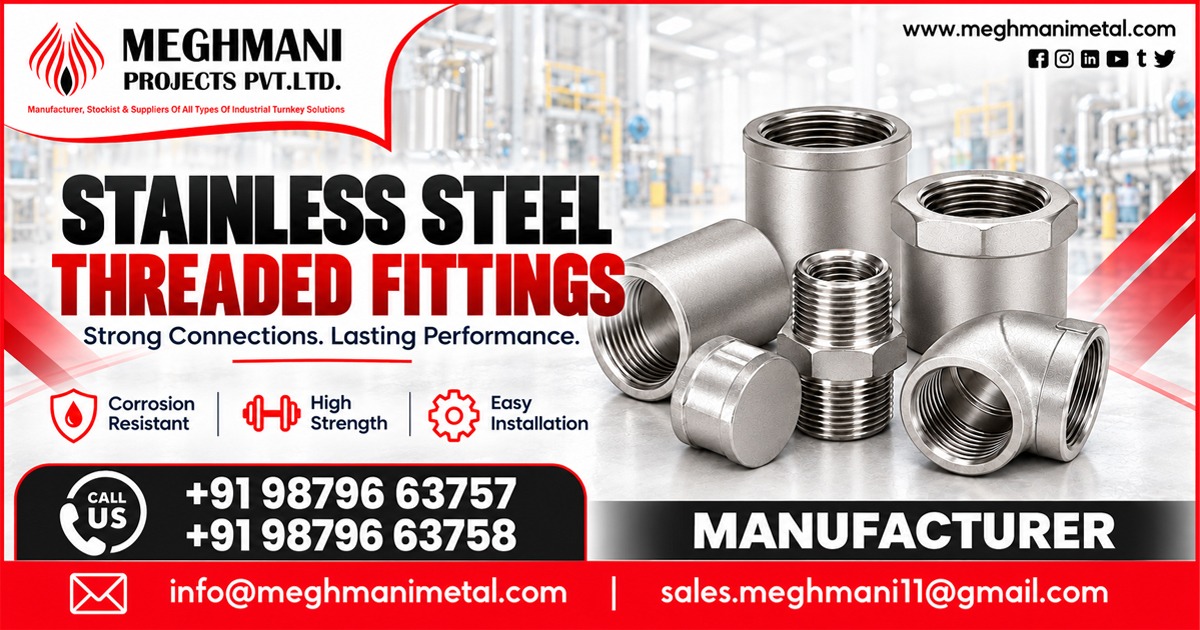
Stainless steel threaded fittings help connect process pipelines securely while supporting inspection, maintenance, and equipment changes. For industries in Dahej, selecting the right fittings involves checking material grade, thread type, pressure requirements, and chemical compatibility. Meghmani Projects Pvt. Ltd. provides a starting point for discussing these industrial requirements.
Where Threaded Fittings Fit Into Industrial Piping Systems
Threaded fittings connect pipes, valves, instruments, and other pipeline components through matching threaded ends. They are commonly considered for smaller-bore piping, utility lines, and applications where threaded connections suit the operating conditions.
In industrial areas such as Dahej, piping may handle water, process fluids, chemicals, or utility services. The fitting must be selected according to the actual fluid and operating environment.
Common fitting types include:
- Elbows: Change the direction of a pipeline.
- Tees: Create a branch connection from a main line.
- Reducers: Connect pipe sections of different sizes.
- Couplings: Join compatible pipe sections.
- Unions: Allow sections to be disconnected more conveniently for maintenance.
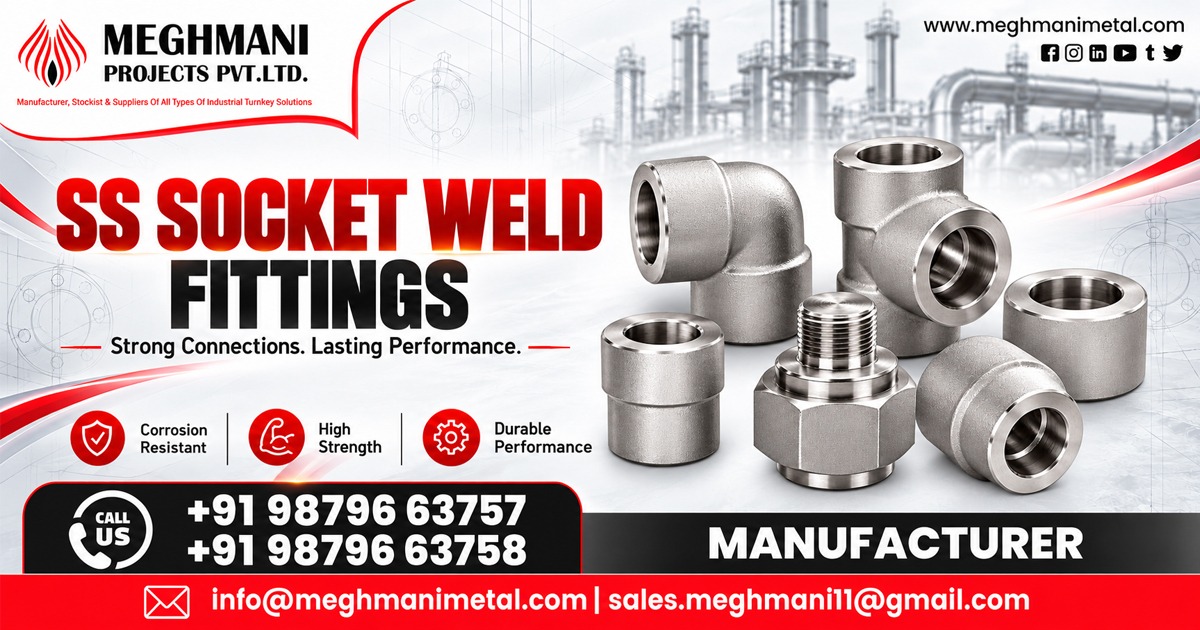
- Plugs and caps: Close suitable threaded openings or pipe ends.
- Nipples: Connect threaded components over short distances.
Not every threaded fitting is suitable for every industrial process. Pressure, temperature, vibration, and fluid properties must be considered before ordering.
What Buyers Should Check Before Selecting Stainless Steel Fittings
A purchase decision should begin with the piping specification rather than the price alone. Buyers searching for a Stainless Steel Threaded Fittings Supplier In Dahej should confirm the following details before requesting a quotation.
- Material grade: Select a grade appropriate for corrosion exposure, chemical composition, and operating temperature. SS 304 and SS 316 are common options, but suitability depends on the service conditions.
- Thread standard: Confirm whether the connection requires BSP, NPT, or another specified thread form. These thread systems should not be assumed interchangeable.
- Nominal size: Match the fitting to the pipe and equipment connection specifications.
- Pressure and temperature: Verify the fitting’s rated operating limits for the intended service.
- Fitting configuration: Identify the required type, connection arrangement, and dimensions.
- Operating environment: Consider moisture, chemical exposure, outdoor installation, and possible chloride contact.
Providing a piping drawing or material specification sheet can help reduce ordering errors and unnecessary replacements.
How Threaded Connections Work and Where They Are Suitable
A threaded fitting creates a mechanical connection when its external or internal threads engage with a matching component. Correct thread engagement and an appropriate sealing method help establish a dependable joint.
A typical installation sequence involves:
- Check the components: Confirm size, thread type, material, and connection compatibility.
- Inspect the threads: Look for visible damage, contamination, or deformation.
- Prepare the joint: Use a sealing method suitable for the fluid, temperature, pressure, and thread specification.
- Assemble correctly: Follow the approved installation procedure and avoid excessive tightening.
- Test the connection: Inspect and test the assembled system according to the project’s safety and commissioning requirements.
Threaded joints can simplify access during maintenance, but they may not be suitable for every high-pressure, high-temperature, vibrating, or hazardous-fluid service. The piping engineer should confirm the connection method against the system design.
Quality Checks That Help Prevent Piping Problems
A fitting that looks correct externally may still have a thread mismatch or an unsuitable material grade. Procurement teams should check more than the product’s appearance.
| Quality checkpoint | What to verify |
| Material identification | Grade and material documentation match the purchase specification |
| Thread quality | Correct thread form, clean engagement, and no visible damage |
| Dimensions | Nominal size and connection dimensions match the drawing |
| Surface condition | No obvious cracks, dents, corrosion, or harmful defects |
| Pressure suitability | Rating is appropriate for the intended service and applicable specifications |
| Traceability | Required inspection documents and material records are available |
For chemical and petrochemical facilities, material selection deserves particular attention. Stainless steel grades differ in their resistance to specific chemicals, acids, chlorides, and process temperatures. A grade suitable for one fluid may not be suitable for another.
Installation Planning for Dahej’s Industrial Environment
Dahej’s industrial projects can involve chemical handling, utility distribution, plant maintenance, and process piping. Before installing threaded components, consider the actual operating environment rather than relying on the general corrosion resistance of stainless steel.
- Allow maintenance access: Position fittings so that inspection and replacement can be carried out safely.
- Check pipe alignment: Avoid forcing misaligned pipes together to engage the threads.
- Review vibration: Assess whether threaded connections are appropriate for equipment with significant vibration or movement.
- Protect against contamination: Keep threads clean during storage, transport, and assembly.
- Confirm sealing compatibility: Select sealants compatible with the process fluid and operating conditions.
- Plan testing: Complete the required leak checks and commissioning tests under the approved site procedure.
These checks help reduce installation mistakes and make future maintenance easier. Installation and testing should be performed by qualified personnel following the project’s piping specifications.
Common Threaded Fitting Issues and Practical Checks
| Common issue | Possible cause | Practical check |
| Leakage at the joint | Incorrect sealant, damaged threads, or unsuitable assembly | Isolate the system safely and inspect according to site procedures |
| Difficulty engaging threads | Wrong thread standard, size mismatch, or damaged threads | Verify the fitting and pipe specifications |
| Corrosion or surface damage | Unsuitable grade, chemical exposure, or poor storage | Review the fluid conditions and material documentation |
| Repeated joint loosening | Vibration, movement, or unsuitable connection design | Ask the piping engineer to review the joint and operating conditions |
Never attempt to tighten or dismantle a pressurized connection. Isolate, depressurize, and make the system safe under the approved site procedure before inspection.
Procurement Mistakes That Can Create Avoidable Costs
When sourcing stainless steel threaded fittings, small specification errors can cause delays, replacement expenses, and installation difficulties.
Avoid these common purchasing mistakes:
- Ordering by nominal size without confirming the thread standard.
- Selecting SS 304 or SS 316 without checking the actual process-fluid compatibility.
- Assuming every stainless steel fitting has the same pressure rating.
- Leaving the fitting type, quantity, and dimensions unclear in the purchase order.
- Failing to request material certificates or inspection records when the project requires them.
- Ignoring delivery schedules, packaging, and identification requirements for large orders.
For buyers comparing a Stainless Steel Threaded Fittings Supplier In Dahej, a clear enquiry should include the material grade, connection type, quantity, operating conditions, applicable specification, and delivery location. This gives suppliers a more accurate basis for preparing a quotation.
Industrial Support From Meghmani Projects Pvt. Ltd.
Meghmani Projects Pvt. Ltd. operates in the industrial metal products sector, with product categories that include industrial fittings, valves, flanges, stainless steel pipes, and other metal products. Its website provides an overview of the company’s product range and manufacturing infrastructure.
With manufacturing support from Ahmedabad, Gujarat, India, the company can be approached to discuss requirements for industrial metal products and piping components. Buyers should confirm the exact threaded fitting type, grade, dimensions, documentation, and availability for their particular order.
Visit the official Meghmani Projects Pvt. Ltd. website to review the available product information and discuss project requirements.
Services
- Industrial piping component requirement assessment and product consultation.
- Assistance with fitting type, material grade, thread specification, and size selection.
- Purchase specification review and coordination for project requirements.
- Enquiry support for product documentation, order details, and delivery planning.
Location
Dahej’s industrial facilities require piping components selected for their specific process and environmental conditions. Buyers sourcing from this industrial region can assess requirements across Dahej, Bharuch, Ankleshwar, Panoli, Jhagadia, Vilayat, Palej, Vagra, Vadodara, Halol, Savli, Nandesari, Ahmedabad, Sanand, Kalol, Gandhinagar, Surat, Hazira, Sachin, Vapi, Ankleshwar GIDC, Bharuch GIDC, Dahej PCPIR, and the Jhagadia Industrial Estate. For every location, material compatibility, thread specifications, and project documentation remain important purchasing considerations.
Frequently Asked Questions
Q: Which stainless steel grade should I choose for threaded fittings in Dahej?
A: SS 304 and SS 316 are common options, but the correct grade depends on the process fluid, chloride exposure, temperature, and operating conditions. Confirm material suitability with the project engineer.
Q: How do I confirm the correct thread type before ordering?
A: Check the piping drawing and connection specification to identify the required thread standard, size, and gender. Do not assume BSP and NPT threads are interchangeable.
Q: Can threaded stainless steel fittings be used in chemical plants?
A: They may be suitable for selected chemical-service lines when the material, pressure rating, temperature, and sealing method are compatible. The piping engineer should approve the connection for the intended duty.
Q: What information should I send a supplier for a quotation?
A: Provide fitting type, material grade, size, thread standard, quantity, operating conditions, required documentation, and delivery location. Drawings or a bill of materials can help clarify the requirement.
Conclusion
Reliable industrial piping starts with fittings that match the system’s material, thread, pressure, and temperature requirements. For projects in Dahej, careful specification checks can prevent compatibility issues and procurement delays. Meghmani Projects Pvt. Ltd., with manufacturing support from Ahmedabad, Gujarat, India, can be contacted to discuss suitable product requirements.
Contact Meghmani Projects Pvt. Ltd. to discuss your threaded fitting requirements, review product specifications, and request guidance for your industrial piping project in Dahej.
Call Us:
Sales: (+91) 98 79 663757
Support: (+91) 98 79 663758
Email Us:
Sales: sales.meghmani11@gmail.com
General: info@meghmanimetal.com
If you have any more questions or customized solutions, please feel free to contact us.