Industrial nuts, bolts and fasteners play an important role in maintaining secure mechanical connections across industrial operations. Businesses seeking reliable fastening components can explore suitable product requirements with Meghmani Projects Pvt. Ltd., with manufacturing support from Ahmedabad, Gujarat, India.
Understanding the Role of Industrial Fasteners in Manufacturing
Industrial fasteners are mechanical components used to join, secure or hold two or more parts together. They are essential in machinery assembly, structural fabrication, equipment installation and infrastructure projects.
Nuts, bolts and other fastening components help maintain stable connections between metal structures and machine parts. Selecting the correct fastener is important because an unsuitable component can lead to loose joints, premature wear, maintenance problems or connection failure.
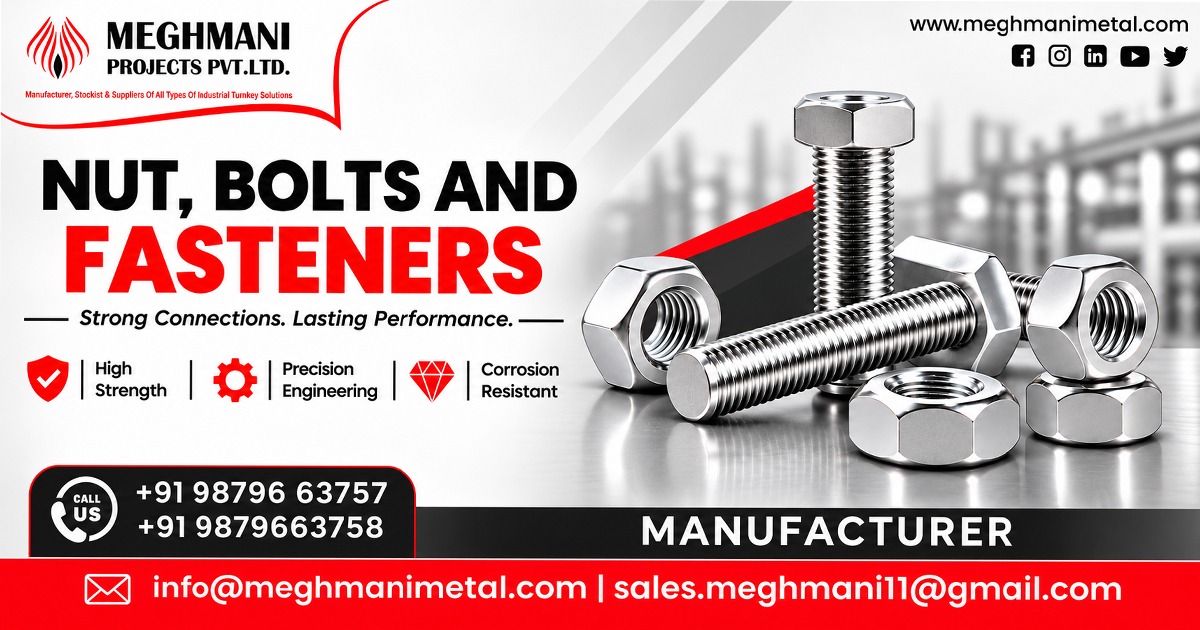
Common industrial fastening components include:
- Hex Bolts: Used for joining structural members, machine components and fabricated assemblies.
- Hex Nuts: Used with compatible bolts to create secure threaded connections.
- Stud Bolts: Suitable for applications requiring threaded engagement at both ends.
- Foundation Bolts: Used to secure equipment and structures to concrete foundations.
- Threaded Rods: Used for suspension, support and fastening arrangements.
- Washers: Help distribute load and protect connected surfaces.
For procurement teams, choosing an appropriate Industrial Nuts, Bolts & Fasteners Manufacturer and Supplier involves understanding the application, material requirements and expected operating conditions rather than focusing only on product price.
How to Select Fasteners for Different Industrial Requirements
Fastener selection should begin with the actual working conditions of the connection. A component suitable for a light-duty assembly may not be appropriate for heavy machinery or outdoor structural installations.
Consider the following factors before purchasing:
| Selection factor | What buyers should check |
| Base material | Confirm compatibility with the connected components |
| Strength requirements | Check the required mechanical strength and load conditions |
| Thread type | Verify thread diameter, pitch and compatibility |
| Dimensions | Confirm length, diameter and head configuration |
| Operating environment | Consider moisture, chemicals, temperature and outdoor exposure |
| Corrosion resistance | Select an appropriate material or protective coating |
| Installation method | Check tool access, tightening requirements and assembly conditions |
| Maintenance | Consider inspection frequency and replacement requirements |
Material selection also matters. Depending on the application, buyers may evaluate carbon steel, alloy steel or stainless steel fasteners. The final choice should consider mechanical requirements, corrosion exposure and compatibility with the connected materials.
How Fasteners Move from Specification to Installation
Unlike complex machinery, fasteners do not have a separate operating cycle. Their performance depends on correct identification, fitting, tightening and inspection.
A typical industrial fastening process involves four stages:
Step 1: Identify the Joint Requirement
Determine which components need to be connected and whether the joint will experience vibration, movement, pressure or external loads.
Step 2: Match the Fastener
Select the appropriate bolt, nut, stud or washer according to dimensions, thread compatibility, material and strength requirements.
Step 3: Complete the Assembly
Clean the contact surfaces, align the holes and fit the components correctly. Tighten the connection using a suitable tool and the specified tightening procedure.
Step 4: Inspect the Connection
Check thread engagement, alignment, tightening condition and visible surface damage. Where necessary, follow a planned inspection schedule to identify loosening or corrosion.
Correct installation is especially important in equipment foundations, structural connections and industrial piping assemblies.
Quality Checks That Matter Before Ordering
A fastener may look suitable externally but still fail to meet the requirements of a particular application. Procurement teams should verify the following details before approving an order:
- Material identification: Confirm whether the supplied material matches the purchase specification.
- Dimensional accuracy: Check bolt diameter, length, thread pitch and nut dimensions.
- Thread condition: Look for damaged, incomplete or poorly formed threads.
- Surface finish: Inspect for corrosion, scratches, coating damage and other visible defects.
- Strength requirements: Verify the specified property class or mechanical requirements wherever applicable.
- Compatibility: Ensure that nuts, bolts and washers are suitable for use together.
- Inspection documents: Request applicable material test reports and inspection records when required.
- Quantity verification: Match the supplied quantity against the purchase order and bill of materials.
For critical connections, buyers should also confirm applicable engineering specifications and testing requirements before finalizing the purchase.
Matching Fastener Requirements to Project Conditions
Industrial projects often require different fastening arrangements even within the same facility. For example, equipment installation may require foundation bolts, while piping assemblies may need compatible stainless steel fasteners.
Before requesting a quotation, prepare the following information:
| Project requirement | Information to provide |
| Product type | Nut, bolt, stud, threaded rod or washer |
| Material | Required metal grade or material specification |
| Dimensions | Diameter, length and thread details |
| Quantity | Total pieces and size-wise breakdown |
| Application | Machinery, piping, fabrication or structural assembly |
| Environment | Indoor, outdoor, chemical or moisture exposure |
| Documentation | Required inspection and material documents |
| Delivery | Required delivery schedule and destination |
Sharing accurate specifications helps suppliers understand the requirement and reduces the possibility of ordering incompatible components.
Services
Meghmani Projects Pvt. Ltd. can be approached for product-related enquiries and industrial material requirements. Relevant support areas include:
- Product Requirement Discussion: Understanding the type, dimensions and material specifications required for industrial fastening applications.
- Product Selection Assistance: Helping buyers identify suitable stainless steel fastener requirements based on their application details.
- Material and Order Coordination: Discussing quantities, product specifications and procurement requirements.
- Technical and Product Enquiries: Providing a communication channel for questions related to available products and order requirements.
Location: Industrial Fastener Requirements Across Gujarat
Manufacturing, engineering, fabrication, chemical processing and infrastructure businesses require dependable fastening components for equipment assembly and structural connections. With manufacturing support from Ahmedabad, Gujarat, India, Meghmani Projects Pvt. Ltd. can be contacted by businesses exploring their industrial fastener requirements across Ahmedabad, Surat, Vadodara, Rajkot, Gandhinagar, Bharuch, Ankleshwar, Dahej, Vapi, Ankleshwar GIDC, Panoli, Jhagadia, Sanand, Changodar, Naroda, Vatva, Kalol, Mehsana, Morbi, Jamnagar, Halol, Savli, Nandesari, Hazira and Gandhidham.
Why Choose Meghmani Projects Pvt. Ltd.?
Selecting the right supplier involves more than comparing quotations. Buyers should consider product suitability, material requirements, specification clarity and procurement coordination.
Meghmani Projects Pvt. Ltd. is an Ahmedabad-based engineering company offering industrial metal products, including stainless steel fasteners. Its website also presents a broader range of metal products, such as stainless steel sheets, pipes, bars, flanges and industrial fittings.
The company has manufacturing support from Ahmedabad, Gujarat, India. Buyers can visit meghmanimetal.com to explore its product range and submit enquiries for their requirements.
Frequently Asked Questions (FAQ)
Q1: What materials are commonly used for industrial nuts and bolts?
A: Common materials include carbon steel, alloy steel and stainless steel. The suitable option depends on load requirements, corrosion exposure, operating temperature and the surrounding environment.
Q2: How can buyers ensure nut and bolt compatibility?
A: Check the thread diameter, pitch, thread type and material compatibility. Nuts and bolts should match the specified dimensions and mechanical requirements to ensure proper assembly.
Q3: When should industrial fasteners be inspected or replaced?
A: Inspection frequency depends on operating conditions, vibration, corrosion exposure and equipment usage. Replace components showing damaged threads, excessive corrosion, deformation or other signs of deterioration.
Q4: What information should I share when requesting a fastener quotation?
A: Provide product type, material grade, dimensions, quantity, application details and delivery location. Technical drawings or an approved bill of materials can help clarify the requirement.
Conclusion
Selecting suitable industrial fastening components requires attention to material quality, dimensions, thread compatibility and operating conditions. Businesses across Gujarat can discuss their procurement requirements with Meghmani Projects Pvt. Ltd., supported by its Ahmedabad manufacturing base and industrial metal product range.
Contact Meghmani Projects Pvt. Ltd. to discuss your industrial nuts, bolts and fastener requirements, product specifications and procurement needs.
Call Us:
Sales: (+91) 98 79 663757
Support: (+91) 98 79 663758
Email Us:
Sales: sales.meghmani11@gmail.com
General: info@meghmanimetal.com