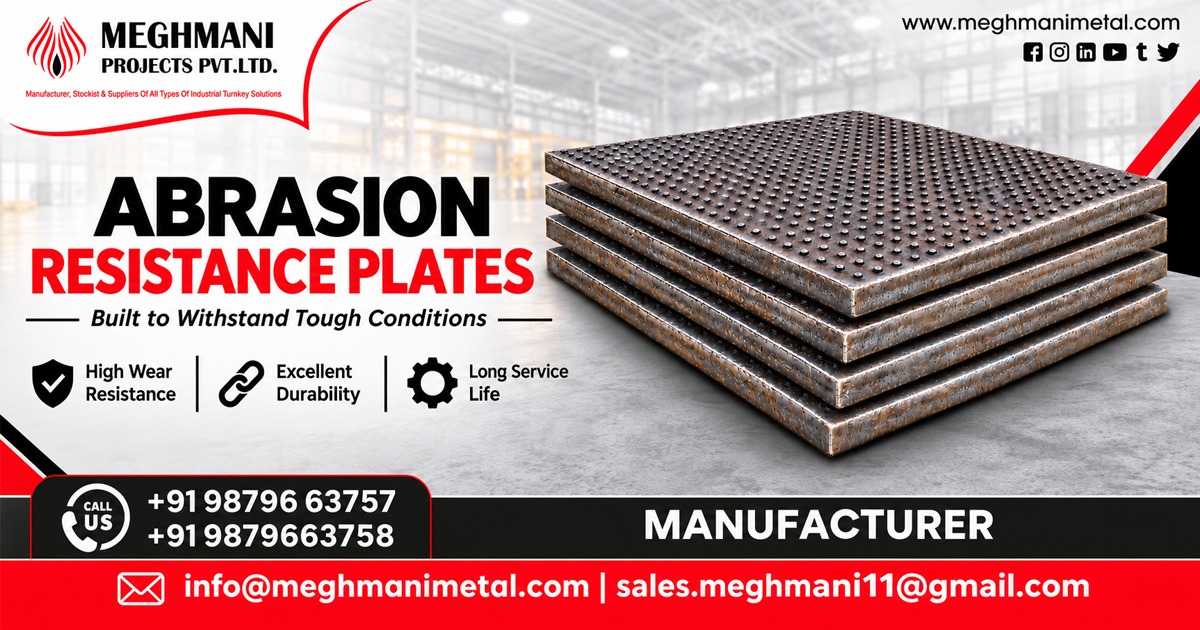
Abrasion Resistant Steel Plates for Heavy-Duty Applications help protect industrial equipment exposed to continuous friction, material impact, and surface wear. In Ahmedabad, Meghmani Projects Pvt. Ltd. provides manufacturing support for industrial metal procurement and project requirements.
Why Industrial Equipment Needs Better Protection Against Surface Wear
In industries handling minerals, cement, coal, aggregates, and other abrasive materials, equipment surfaces gradually lose thickness through repeated contact.
This wear can affect equipment dimensions, maintenance schedules, and production continuity.
Abrasion-resistant steel is designed to reduce material loss in such operating conditions.
Common areas where wear protection becomes important include:
- Material handling systems: Chutes, hoppers, transfer points, and conveyor liners experience repeated contact with moving materials.
- Mining equipment: Excavation and material transportation components face friction from rocks, minerals, and aggregates.
- Cement processing units: Clinker, limestone, and other raw materials can cause continuous surface abrasion.
- Industrial storage equipment: Bins and storage hoppers may experience wear where bulk materials slide or discharge.
- Heavy fabrication: Equipment components exposed to regular material contact may require additional wear resistance.
The actual wear pattern depends on material hardness, particle shape, movement speed, impact force, and operating conditions.
Understanding How Wear-Resistant Plates Perform Under Continuous Material Contact
Abrasion-resistant plates are generally manufactured from specially processed steel designed to withstand surface wear.
Many commonly used grades are produced through controlled heat treatment, including quenching and tempering. Their hardness and mechanical properties help them resist material removal during abrasive contact.
Three common wear conditions influence their selection:
1. Sliding Abrasion
This occurs when particles move across the steel surface. Conveyor liners, chutes, and hopper walls frequently experience this type of contact.
2. Impact Abrasion
This happens when hard materials strike a steel surface while also causing wear. Loading points, crushers, and material transfer equipment can experience these conditions.
3. Gouging and Heavy Contact Wear
Large or sharp materials can create deep scratches, grooves, and local surface damage. Equipment handling irregular rocks, scrap, and heavy aggregates may face these conditions.
A plate suitable for sliding abrasion may not automatically perform equally well under severe impact. Therefore, understanding the actual operating environment is essential.
How to Select the Right Plate Grade for Your Operating Conditions
Selecting a steel plate only by its hardness value can create problems during fabrication and operation.
The right grade should balance abrasion resistance, toughness, thickness, and fabrication requirements.
Consider these factors before finalising a purchase:
- Hardness requirement: Compare the specified hardness range with the type and severity of abrasive contact.
- Impact resistance: Equipment receiving falling or moving heavy materials may need a suitable balance between hardness and toughness.
- Plate thickness: Consider expected wear, structural loading, fabrication limitations, and replacement requirements.
- Operating temperature: Check whether the selected material is suitable for the temperature conditions of the equipment.
- Material dimensions: Confirm length, width, thickness, and cutting requirements according to the fabrication drawing.
- Welding requirements: Review the recommended welding procedure, consumables, and preheating requirements for the selected grade.
- Maintenance planning: Consider how easily worn liners or plate sections can be inspected and replaced.
Buyers should request the manufacturer’s technical datasheet and verify the specified hardness, chemical composition, and mechanical properties rather than relying on a grade name alone.
Fabrication and Installation Decisions That Affect Plate Performance
Even a suitable steel grade can experience premature problems if fabrication and installation are not properly planned.
Abrasion-resistant materials may require different handling procedures compared with conventional mild steel.
Important fabrication considerations:
- Cutting: Select an appropriate cutting process according to plate thickness, grade, and workshop capability.
- Drilling: Confirm suitable tooling and machining recommendations before producing holes.
- Bending: Check the minimum recommended bend radius and forming limitations.
- Welding: Follow the grade-specific welding procedure, including appropriate consumables and temperature controls.
- Surface preparation: Remove unwanted contamination and prepare joining surfaces according to the fabrication requirements.
Installation planning should include:
- Verify supporting structures and mounting arrangements.
- Check the alignment of liner plates and adjoining sections.
- Ensure fasteners or welded connections suit the application.
- Avoid unnecessary gaps where abrasive materials can accumulate.
- Provide access for inspection and future replacement.
- Confirm that the installed plate does not interfere with material flow.
For critical equipment, fabrication and installation should follow approved engineering drawings and material supplier recommendations.
Inspection and Troubleshooting: Identifying Early Signs of Plate Wear
Regular inspection helps maintenance teams identify deterioration before it affects equipment operation.
Instead of waiting for visible damage, inspect high-contact areas during planned maintenance activities.
| Common Issue | Possible Cause | Practical Check |
| Uneven surface wear | Irregular material flow or concentrated abrasion | Inspect material contact points |
| Deep scratches and grooves | Sharp particles or heavy sliding contact | Review material characteristics |
| Localised plate damage | Repeated impact or concentrated loading | Examine loading and transfer areas |
| Cracks near welds | Fabrication stress or unsuitable welding practice | Arrange qualified weld inspection |
| Loose liner sections | Fastener loosening or connection problems | Inspect mounting arrangements |
| Premature thickness reduction | Incorrect grade or insufficient thickness | Compare measurements with design requirements |
Maintenance practices to follow:
- Monitor plate thickness at frequently exposed locations.
- Inspect weld joints, mounting points, and supporting structures.
- Check for cracks, deformation, and loose connections.
- Record wear patterns to identify sections requiring frequent replacement.
- Keep suitable replacement material details available.
- Follow the supplier’s recommendations for inspection and maintenance.
Any cracked or structurally damaged component should be assessed by qualified maintenance personnel before continued operation.
Material Verification and Purchase Checks Before Placing an Order
Procurement teams should verify the complete material requirement before issuing a purchase order.
A clear specification reduces the possibility of receiving a plate that does not match the intended operating conditions.
Use this checklist:
Industrial plate procurement checklist
- Confirm the required abrasion-resistant steel grade.
- Verify the hardness range and measurement requirements.
- Check the chemical composition and mechanical properties.
- Confirm plate thickness, length, and width.
- Review applicable material specifications and standards.
- Request the material test certificate, where applicable.
- Verify heat number and material traceability.
- Discuss cutting, drilling, and fabrication requirements.
- Confirm inspection and testing documentation.
- Clarify delivery schedule and transportation arrangements.
Buyers should also avoid these common purchasing mistakes:
- Selecting a harder grade without evaluating impact conditions.
- Ordering plate thickness without considering wear allowance.
- Ignoring welding and forming limitations.
- Comparing quotations without checking material documentation.
- Failing to confirm whether the supplied grade matches the equipment design.
Material certificates and inspection documents should correspond to the actual supplied material and the purchase specification.
Industrial Metal Procurement and Project Assistance From Meghmani Projects Pvt. Ltd.
Meghmani Projects Pvt. Ltd. operates from Ahmedabad, Gujarat, India, and its website, meghmanimetal.com, presents an industrial metal product portfolio covering sheets, plates, coils, pipes, tubes, bars, structural products, and other metal materials.
For abrasion-resistant steel plate requirements, buyers should discuss the exact grade, dimensions, hardness, technical specifications, and application with the company to confirm product availability and supply suitability.
The company can be approached for the following project-related services:
Services
- Industrial Material Requirement Assessment: Discuss equipment operating conditions, wear exposure, and project material requirements.
- Plate Grade and Specification Consultation: Review required dimensions, hardness, material properties, and technical documentation.
- Material Procurement and Project Coordination: Coordinate product specifications and supply requirements for industrial applications.
- Technical and Supply Assistance: Assist with material-related queries, documentation requirements, and procurement coordination.
The company website provides further information about its metal product range and industrial supply activities. Buyers should confirm the availability of the specific wear-resistant grade before finalising their orders.
Location
Ahmedabad is an important industrial and engineering centre where manufacturing, fabrication, construction, and material-handling businesses require suitable metal products. Meghmani Projects Pvt. Ltd. provides manufacturing support from Ahmedabad, Gujarat, India, for industrial procurement requirements across Ahmedabad, Sanand, Changodar, Bavla, Dholka, Vatva, Odhav, Naroda, Kathwada, Chhatral, Kalol, Kadi, Mehsana, Gandhinagar, Vadodara, Savli, Halol, Bharuch, Ankleshwar, Dahej, Vapi, Surat, Rajkot, and Morbi.
Frequently Asked Questions
Q: What makes abrasion-resistant steel different from regular mild steel?
A: Abrasion-resistant steel is developed to withstand surface wear caused by repeated friction and abrasive materials. Regular mild steel may experience faster material loss in demanding wear conditions.
Q: Does a higher hardness grade always provide better wear performance?
A: No. Hardness is only one selection factor. Impact resistance, toughness, operating conditions, fabrication requirements, and material characteristics must also be considered.
Q: Can these plates be cut, drilled, and welded?
A: Yes, subject to the selected grade and its fabrication limitations. Cutting methods, drilling tools, welding procedures, and preheating requirements should follow the manufacturer’s recommendations.
Q: What documents should buyers request when purchasing wear-resistant plates?
A: Buyers should request the relevant material test certificate, chemical composition, mechanical property details, hardness information, and applicable inspection documents according to the purchase specification.
Conclusion
Industrial equipment exposed to continuous abrasive contact requires suitable material selection to manage wear and maintenance requirements. Abrasion-resistant steel plates offer a practical option when grade, hardness, thickness, and impact conditions are properly evaluated. Meghmani Projects Pvt. Ltd. provides manufacturing support from Ahmedabad, Gujarat, India, for industrial metal procurement discussions.
Planning an industrial wear-protection project? Contact Meghmani Projects Pvt. Ltd. to discuss your plate specifications, material requirements, product availability, and procurement needs.
Website: https://meghmanimetal.com/home/
Call Us:
Sales: (+91) 98 79 663757
Support: (+91) 98 79 663758
Email Us:
Sales: sales.meghmani11@gmail.com
General: info@meghmanimetal.com