Industrial pipelines require accurately matched fittings to maintain secure connections, proper alignment, and reliable fluid movement. Precision SS Socket Weld Fittings for Pipeline Connections help engineers address compact piping requirements, with Meghmani Projects Pvt. Ltd. providing manufacturing support from Ahmedabad, Gujarat, India.
How Socket Weld Fittings Create Secure Pipeline Junctions
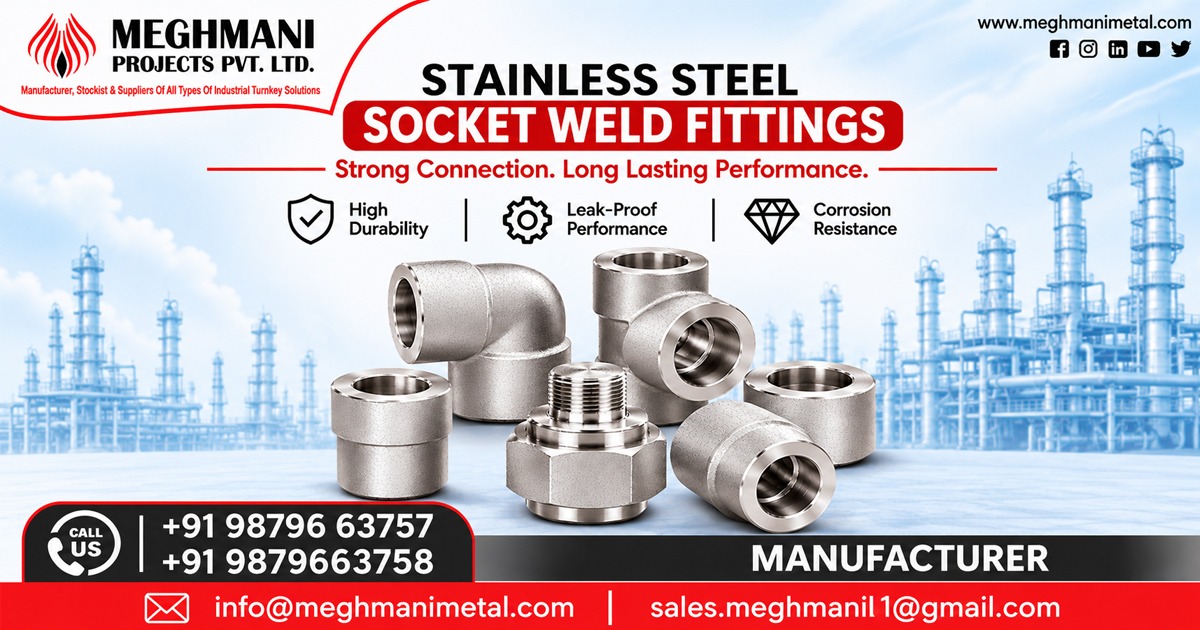
Socket weld fittings are used to connect smaller-bore pipes in industrial piping systems. In this arrangement, the pipe end is inserted into a recessed socket in the fitting and joined through a fillet weld around the connection.
Unlike threaded connections, socket weld joints use welding to secure the pipe and fitting together.
Common fitting configurations include:
- Socket Weld Elbows: Used to change the direction of pipeline flow, commonly at 45° or 90°.
- Socket Weld Tees: Used when a pipeline needs a branch connection.
- Socket Weld Couplings: Connect two pipe sections in a straight line.
- Socket Weld Unions: Allow a connection to be separated where the selected design permits.
- Socket Weld Caps: Close the end of a pipeline.
- Socket Weld Crosses: Provide connections in four directions.
These components are used in piping arrangements where compact dimensions, welded connections, and suitable pressure-rated components are required.
Where These Fittings Fit Into Industrial Piping Systems
The selection of a pipe fitting depends on the process layout, fluid characteristics, operating pressure, and installation conditions.
Stainless steel socket weld fittings can be considered for piping requirements across several industries.
1. Chemical and Petrochemical Plants
Process pipelines carrying compatible chemicals require fittings with suitable corrosion resistance and material properties.
2. Pharmaceutical Manufacturing
Utility and process piping arrangements may use stainless steel components depending on hygiene, cleaning, and process requirements.
3. Oil and Gas Facilities
Smaller-bore auxiliary pipelines, instrument connections, and selected process lines may require socket weld connections.
4. Power Generation Units
Steam-related auxiliary systems and other industrial utility lines require fittings selected according to their operating conditions.
5. Food and Beverage Processing
Stainless steel piping components may be used in compatible utility and process systems where material selection and surface condition matter.
6. General Engineering and Manufacturing
Equipment connections, compressed-air lines, and industrial utility networks can incorporate these fittings where the piping design permits.
Technical Details Buyers Should Match Before Placing an Order
The fitting should match the pipe and the actual operating conditions. A mismatch in dimensions, material grade, or pressure classification can create installation difficulties and affect joint performance.
When sourcing Precision SS Socket Weld Fittings for Pipeline Connections, buyers should evaluate the following points:
- Stainless Steel Grade: SS 304, SS 304L, SS 316, and SS 316L are common grades to evaluate according to corrosion exposure and process requirements. Availability should be confirmed with the supplier.
- Nominal Pipe Size: Check the fitting size against the connected pipe size.
- Pressure Class: Verify the required rating against the piping design and applicable specification.
- Fitting Configuration: Specify whether the requirement involves elbows, tees, couplings, unions, caps, or other configurations.
- Socket Dimensions: Check socket bore, depth, and related dimensional requirements.
- Operating Temperature: Confirm that the selected material and fitting specification suit the working temperature.
- Fluid Compatibility: Consider chemical composition, concentration, and corrosion exposure.
- Applicable Standard: Confirm whether ASME B16.11 or another specified standard governs the purchase.
A procurement team should share the piping specification or bill of materials with the supplier rather than relying only on a product name.
Understanding the Socket Weld Connection Process
A socket weld connection involves accurate pipe preparation, fitting positioning, and controlled welding.
The general installation sequence includes:
Step 1 – Pipe Preparation
The pipe end is checked for correct dimensions, cleanliness, and suitable surface condition before assembly.
Step 2 – Fitting Positioning
The pipe is inserted into the fitting socket. Proper alignment is checked to avoid unnecessary stress or angular deviation.
Step 3 – Root Clearance
The recommended gap between the pipe end and socket shoulder is maintained according to the applicable piping and welding procedure. This allowance helps accommodate thermal expansion during welding.
Step 4 – Tack Welding and Alignment
The assembly is positioned and secured according to the approved welding procedure.
Step 5 – Final Welding
A qualified welder completes the joint using the specified welding procedure and suitable consumables.
Step 6 – Inspection
The completed joint is examined according to project inspection requirements before the pipeline proceeds to testing or commissioning.
Correct preparation and welding practices are essential because dimensional mismatch or poor alignment can affect joint quality.
Installation Conditions That Influence Joint Performance
Even a correctly selected fitting can create problems if the pipeline installation is poorly planned.
Before installation, the project team should consider:
- Pipe Alignment: Avoid forcing pipes into position to compensate for dimensional differences.
- Welding Access: Provide enough working clearance for proper joint preparation and welding.
- Thermal Expansion: Account for temperature-related movement in the overall pipeline design.
- Pipe Support: Position supports to avoid excessive loads on fittings and welded connections.
- Material Identification: Keep different stainless steel grades properly identified during fabrication.
- Welding Procedure: Follow the approved welding procedure and applicable project requirements.
For industrial installations, welding inspection, pressure testing, and commissioning should follow the approved engineering documentation.
Inspection Practices for Long-Term Piping Reliability
Socket weld fittings do not generally require the same routine servicing as mechanical equipment. However, the connected piping system needs regular inspection based on its operating environment.
| Common Issue | Possible Cause | Practical Check |
| Leakage near the joint | Weld defect or joint damage | Arrange inspection under an approved procedure |
| Visible corrosion | Unsuitable material or environmental exposure | Review grade and corrosion conditions |
| Pipeline vibration | Inadequate support or operating disturbance | Check supports and vibration sources |
| Joint cracking | Excessive stress or thermal movement | Arrange engineering assessment |
| Misalignment | Incorrect fabrication or assembly | Review installation dimensions |
Additional inspection considerations include:
- Check exposed fittings for corrosion, deformation, and external damage.
- Review pipe supports and nearby connections for unusual movement.
- Maintain material traceability where required by the project.
- Follow specified non-destructive examination and pressure-testing requirements.
- Investigate repeated leakage instead of treating it as an isolated maintenance issue.
Inspection frequency should depend on plant operating conditions, project specifications, and the maintenance programme.
Evaluating Fitting Quality Before Procurement
Purchasing teams should verify the product details before approving a bulk order or dispatching materials to a project site.
Use this checklist during supplier evaluation:
- Material Verification: Confirm the stainless steel grade against the purchase specification.
- Dimensional Inspection: Verify socket depth, bore dimensions, fitting size, and overall geometry.
- Surface Condition: Check for visible cracks, dents, rough finishing, or handling damage.
- Standard Compliance: Confirm the applicable manufacturing and dimensional standard.
- Documentation: Request material test certificates, inspection records, and traceability documents wherever required.
- Quantity Verification: Match the supplied quantities and fitting configurations with the bill of materials.
- Packaging: Check that fittings are protected against contamination, moisture, and physical damage during transportation.
One common procurement mistake is ordering fittings based only on nominal pipe size. Buyers should also confirm the pressure class, material grade, end connection, and dimensional requirements.
Industrial Fitting Procurement Support From Meghmani Projects Pvt. Ltd.
Meghmani Projects Pvt. Ltd. deals in industrial fittings and stainless steel products for different industrial requirements. Its website lists socket weld fittings within its industrial fitting range.
For buyers sourcing Precision SS Socket Weld Fittings for Pipeline Connections, the company can be approached to discuss product requirements, material selection, and supply specifications.
The company offers manufacturing support from Ahmedabad, Gujarat, India, serving industrial procurement requirements across different sectors.
Visit the official website: Meghmani Projects Pvt. Ltd. – Official Website.
Services
1. Industrial Fitting Consultation: Assistance in identifying suitable fitting configurations according to pipeline requirements.
2. Material and Grade Selection: Guidance on evaluating stainless steel grades and material compatibility.
3. Product Sourcing and Supply: Support for industrial fittings and related stainless steel piping components.
4. Technical Requirement Coordination: Assistance with product specifications, dimensional requirements, and procurement documentation.
Location
Ahmedabad’s engineering and industrial ecosystem supports procurement requirements for stainless steel fittings, piping components, and related metal products. Meghmani Projects Pvt. Ltd. provides manufacturing support from Ahmedabad, Gujarat, India, for buyers across Ahmedabad, Gandhinagar, Vadodara, Surat, Rajkot, Jamnagar, Bhavnagar, Bharuch, Ankleshwar, Vapi, Valsad, Navsari, Anand, Nadiad, Mehsana, Kalol, Kadi, Sanand, Changodar, Vatva, Naroda, Odhav, Dahej, and Morbi.
Frequently Asked Questions
Q: What is the main difference between socket weld and threaded pipe fittings?
A: Socket weld fittings connect pipes through welded joints, whereas threaded fittings use matching internal and external threads. The suitable connection depends on piping design, operating conditions, and maintenance requirements.
Q: Which stainless steel grade should be selected for socket weld fittings?
A: SS 304 and SS 316 are commonly evaluated for industrial piping. SS 316 may be considered for certain more corrosive environments, but the final choice depends on the actual fluid, temperature, and chemical exposure.
Q: Which standard is commonly used for stainless steel socket weld fittings?
A: ASME B16.11 is a commonly specified standard for forged socket-welding and threaded fittings. Buyers should confirm the required standard and applicable edition against project documentation.
Q: What information should be shared when requesting a fitting quotation?
A: Provide the material grade, nominal size, pressure class, fitting type, applicable standard, quantity, and required documentation. Sharing a piping specification or bill of materials can help avoid ordering mismatches.
Conclusion
Reliable pipeline connections depend on more than fitting dimensions. Material compatibility, socket geometry, welding quality, and inspection requirements all influence the final installation. Industrial buyers in Ahmedabad and across Gujarat can approach Meghmani Projects Pvt. Ltd. to discuss suitable fitting specifications and procurement requirements.
Discuss Your Industrial Fitting Requirements
Planning a stainless steel piping project? Contact Meghmani Projects Pvt. Ltd. to discuss fitting specifications, material requirements, product selection, and industrial procurement needs.
Website: https://meghmanimetal.com/home/
Call Us:
Sales: (+91) 98 79 663757
Support: (+91) 98 79 663758
Email Us:
Sales: sales.meghmani11@gmail.com
General: info@meghmanimetal.com