Industrial piping systems require fittings that can handle operating pressure, temperature, and mechanical stress without compromising pipeline connections. Businesses looking for a Carbon Steel Fittings Supplier In Bengaluru can consider suitable product options from Meghmani Projects Pvt. Ltd. for their project requirements.
Understanding the Role of Carbon Steel Fittings in Industrial Pipelines
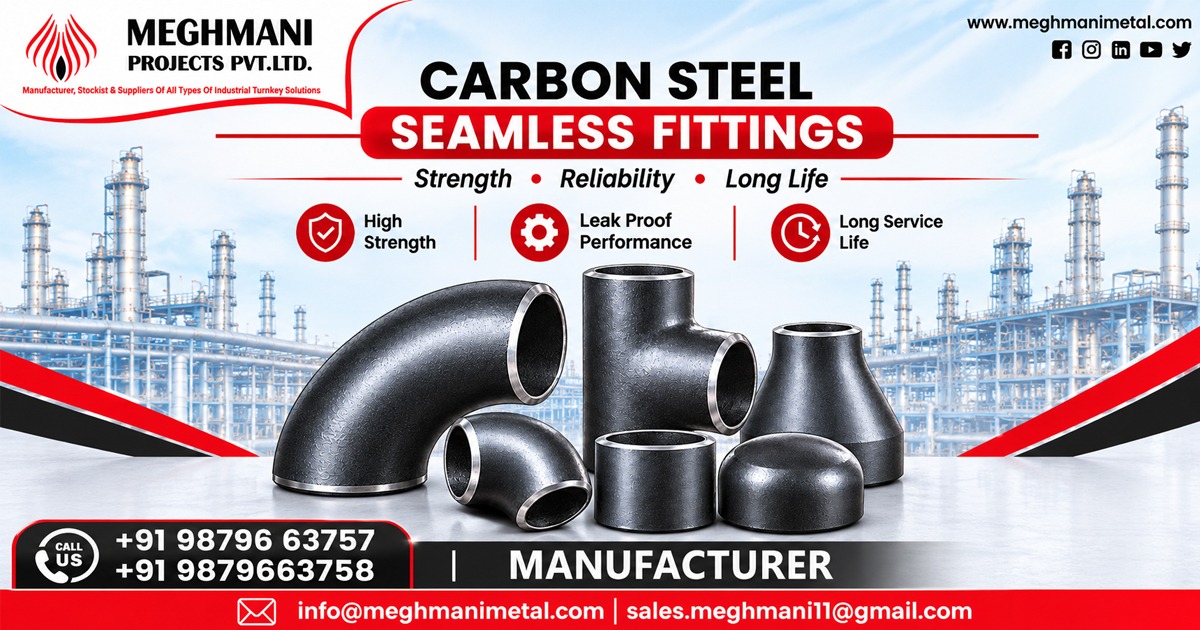
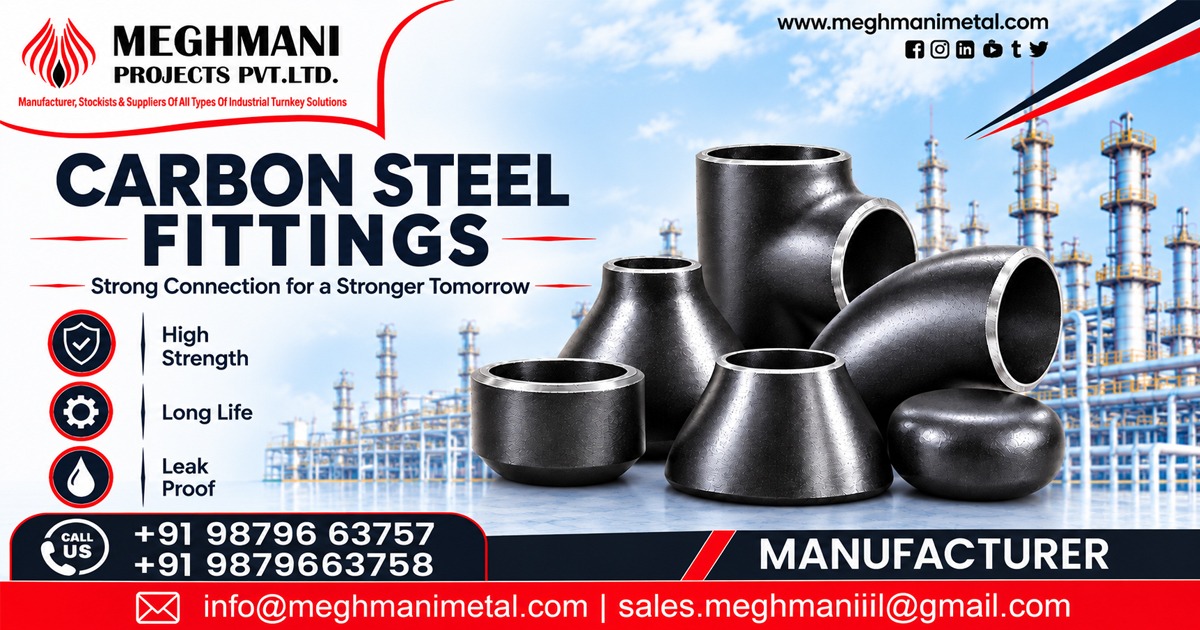
Carbon steel fittings are essential components used to connect, redirect, branch, or change the diameter of industrial pipelines. They help create a properly arranged piping network for transporting liquids, gases, steam, and other process materials.
These fittings are commonly required in industries where pipeline reliability and mechanical strength are important.
Common fitting types include:
- Elbows: Change the direction of pipeline flow, commonly at 45° and 90°.
- Tees: Create branch connections from the main pipeline.
- Reducers: Connect pipes with different diameters.
- Concentric Reducers: Maintain a common centreline while changing pipe size.
- Eccentric Reducers: Provide an offset connection for specific pipeline arrangements.
- Caps: Close the end of a pipeline.
- Bends: Provide directional changes in piping layouts.
Selecting the correct fitting helps maintain pipeline alignment and reduces the chances of connection-related problems.
What Should Buyers Check Before Selecting Carbon Steel Fittings?
The right fitting depends on the pipeline design and actual working conditions. Buyers should evaluate the following points before finalising their purchase.
| Selection Factor | What to Check |
| Material Grade | Confirm compatibility with the piping material and project requirements. |
| Pressure Rating | Check the operating and design pressure of the pipeline. |
| Temperature | Consider the minimum and maximum working temperature. |
| Pipe Schedule | Match fitting dimensions with the connected pipe. |
| Connection Type | Identify butt weld, socket weld, or threaded requirements. |
| Dimensions | Verify diameter, thickness, and end-to-end measurements. |
| Corrosion Conditions | Evaluate the process fluid and surrounding environment. |
Important purchasing consideration: A fitting should not be selected only by nominal pipe size. Material grade, wall thickness, pressure requirements, and dimensional compatibility must also be checked.
How Carbon Steel Fittings Become Part of a Piping Network
Understanding the installation sequence helps project engineers and maintenance teams avoid common pipeline connection problems.
Step 1: Review the Piping Layout
Check the engineering drawing to identify connection points, flow direction, pipe sizes, and required fitting angles.
Step 2: Match the Fitting Dimensions
Verify the fitting diameter, wall thickness, end preparation, and material grade against the piping specifications.
Step 3: Prepare the Connection
Clean the pipe ends and fitting surfaces. For welded connections, ensure proper alignment and follow the approved welding procedure.
Step 4: Inspect the Completed Joint
Check the joint for alignment, welding quality, and visible defects. Conduct the required inspection and pressure testing according to project specifications before commissioning.
Proper installation helps reduce leakage risks, unwanted stress, and premature pipeline maintenance.
Quality Checks That Matter When Purchasing Pipe Fittings
For industrial buyers, product quality involves more than the external appearance of a fitting. Each component should match the engineering requirements of the intended application.
Before placing an order, verify:
- Material Identification: Check the material grade and relevant material documentation.
- Dimensional Accuracy: Confirm outside diameter, wall thickness, and fitting dimensions.
- Surface Condition: Look for cracks, dents, corrosion, and visible manufacturing defects.
- End Preparation: Check bevelled ends and connection surfaces for welding compatibility.
- Traceability: Ask for applicable material test certificates and batch identification.
- Inspection Requirements: Confirm whether additional testing or third-party inspection is required.
- Order Consistency: Ensure all supplied fittings match the approved purchase specifications.
These checks are particularly important for projects involving multiple pipe sizes and different operating conditions.
Avoiding Pipeline Problems Through Proper Fitting Selection
Incorrect fitting selection can create installation difficulties and affect the performance of an entire piping system.
Some common issues include:
- Mismatch in wall thickness: Can complicate welding and joint preparation.
- Incorrect fitting dimensions: May create alignment problems during installation.
- Unsuitable material grade: Can affect performance under actual operating conditions.
- Poor surface condition: May indicate handling or manufacturing-related concerns.
- Wrong reducer arrangement: Can interfere with the intended pipeline layout.
For maintenance teams, keeping fitting specifications and replacement records helps simplify future procurement and repair work.
Services
- Carbon steel fitting requirement assessment and product consultation.
- Assistance with fitting type, dimensions, and material selection.
- Manufacturing coordination and project-specific supply planning.
- Technical assistance for product specifications and procurement requirements.
Location
Bengaluru has a strong industrial presence, with engineering, manufacturing, infrastructure, fabrication, and process industries requiring dependable piping components. Carbon steel fittings are relevant to projects across Bengaluru, Peenya, Bommasandra, Jigani, Bidadi, Electronic City, Whitefield, Hosur Road, Doddaballapur, Nelamangala, Devanahalli, Hoskote, Yelahanka, Rajajinagar, Mahadevapura, Kumbalgodu, Attibele, Anekal, Dobbaspet, Tumakuru, Mysuru, Mangaluru, Hubballi, Belagavi, and Davanagere.
How Meghmani Projects Pvt. Ltd. Supports Industrial Fitting Requirements
Selecting an industrial piping supplier involves understanding product specifications, project quantities, and delivery expectations. Meghmani Projects Pvt. Ltd. supports buyers with manufacturing support from Ahmedabad, Gujarat, India.
The company can be approached for discussions regarding carbon steel fitting requirements, product specifications, and procurement planning.
Visit the official website, meghmanimetal.com, to learn more about the company and discuss your industrial piping requirements.
Frequently Asked Questions
Q1: Which carbon steel fittings are commonly used in industrial piping?
A: Elbows, tees, reducers, caps, and bends are commonly used. The selection depends on pipeline direction, branching requirements, and connected pipe dimensions.
Q2: How do I select the correct pressure rating for a carbon steel fitting?
A: Consider the pipeline design pressure, operating temperature, material grade, and applicable project specifications. The fitting rating must be suitable for the complete piping system.
Q3: Are carbon steel fittings suitable for high-temperature applications?
A: Certain carbon steel grades are suitable for elevated-temperature applications. However, the correct grade must be selected according to temperature, pressure, and service conditions.
Q4: What documents should I request when purchasing carbon steel fittings?
A: Request applicable material test certificates, dimensional details, material grade information, and inspection documents as specified in your purchase order.
Conclusion
Reliable pipeline connections start with correctly selected fittings. Buyers should evaluate material grade, dimensions, pressure requirements, and installation conditions before purchasing. Businesses in Bengaluru can discuss their requirements with Meghmani Projects Pvt. Ltd., backed by manufacturing support from Ahmedabad, Gujarat, India.
Looking for carbon steel fittings for your industrial piping project? Contact Meghmani Projects Pvt. Ltd. to discuss product specifications, material requirements, and procurement assistance.
Call Us:
Sales: (+91) 98 79 663757
Support: (+91) 98 79 663758
Email Us:
Sales: sales.meghmani11@gmail.com
General: info@meghmanimetal.com
If you have any more questions or customized solutions, please feel free to contact us.