Industrial piping networks require reliable fittings to connect pipelines, manage flow direction, and maintain secure joints. Carbon Steel Pipe Fittings for Industrial Piping Networks provide practical connection solutions for demanding industrial environments. Meghmani Projects Pvt. Ltd. supports industrial requirements from Ahmedabad, Gujarat, India.
Understanding the Role of Carbon Steel Fittings in Pipeline Systems
Carbon steel pipe fittings are essential components used to connect, redirect, branch, or change the diameter of industrial pipelines. They help create a functional piping arrangement according to the requirements of a particular process.
In industrial facilities, pipelines transport liquids, gases, steam, and other process materials. Without properly selected fittings, maintaining the required pipeline layout and connection integrity can become difficult.
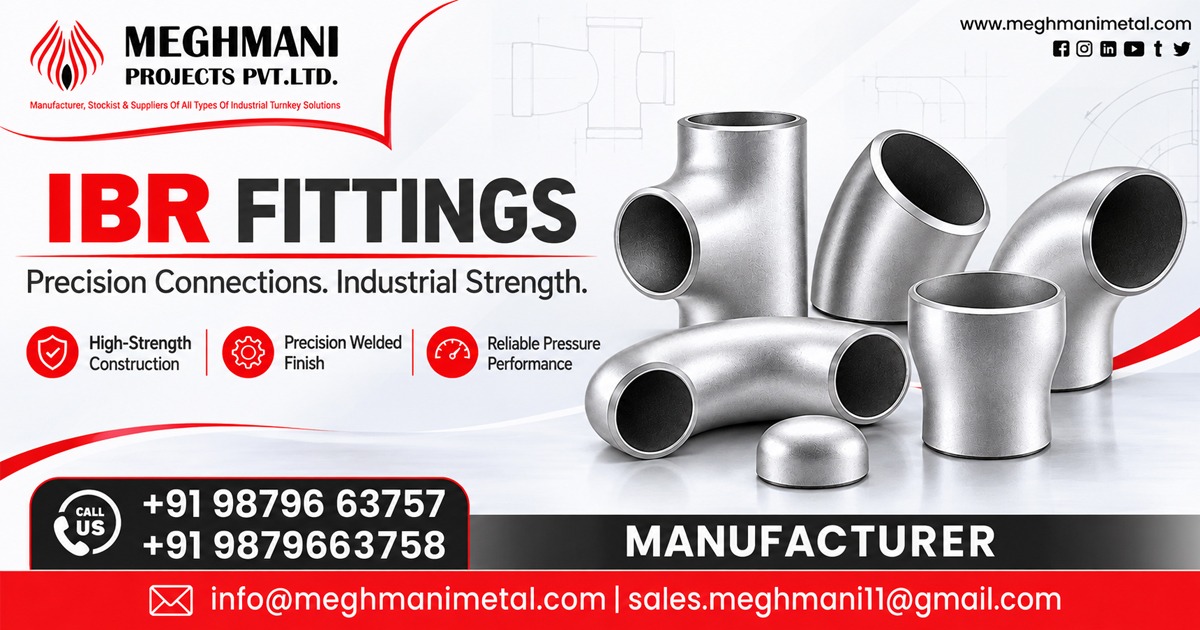
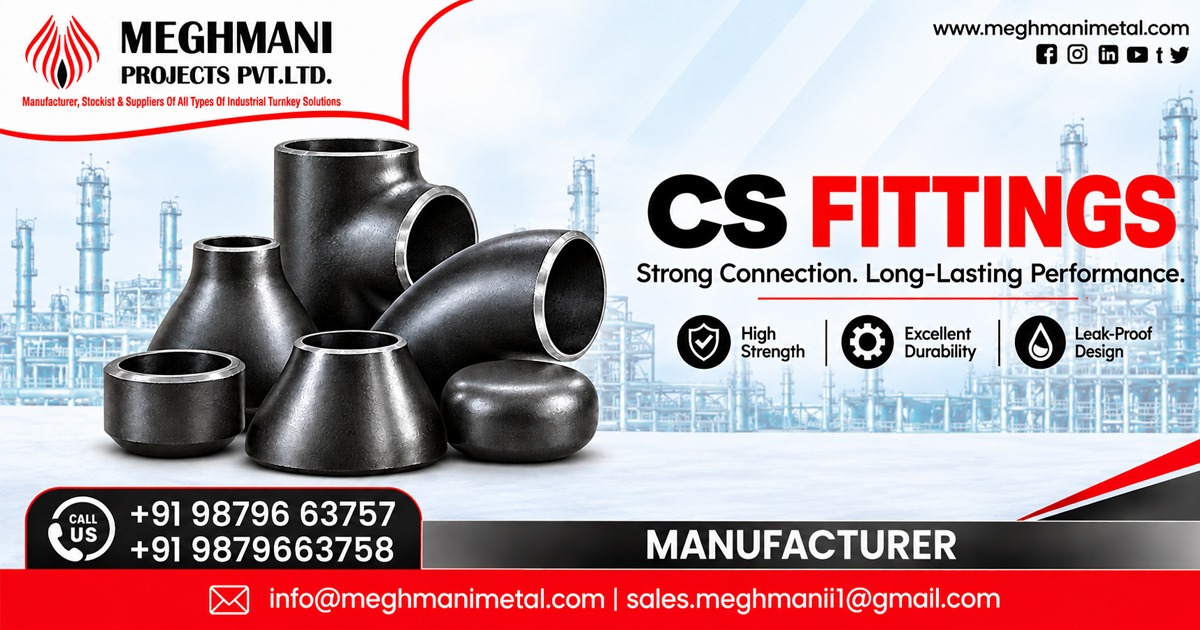
Common fitting types include:
- Elbows: Change the direction of pipeline flow, commonly at 45° or 90° angles.
- Tees: Create branch connections from the main pipeline.
- Reducers: Connect pipes with different diameters.
- Concentric Reducers: Reduce pipe diameter while maintaining a common centreline.
- Eccentric Reducers: Connect different pipe sizes with an offset arrangement.
- Caps: Close the end of a pipeline.
- Pipe Bends: Provide directional changes according to pipeline layout requirements.
These components are used in chemical processing, oil and gas facilities, power plants, water treatment systems, refineries, and general manufacturing industries.
Selecting Pipe Fittings According to Pipeline Conditions
Choosing the correct fitting requires more than matching the pipe diameter. Buyers should evaluate the complete operating conditions before finalising their requirements.
Important selection factors include:
1. Material Grade
Carbon steel fittings are available in different material grades. Select the appropriate grade according to the application, mechanical requirements, and operating environment.
2. Pipe Size and Dimensions
Check the nominal pipe size, outside diameter, wall thickness, and connection dimensions to ensure compatibility with the existing pipeline.
3. Pressure and Temperature
Consider the maximum operating pressure and temperature. The selected fitting must be suitable for the intended service conditions.
4. Fitting Configuration
Identify whether the project requires elbows, tees, reducers, caps, or other configurations based on the pipeline drawing.
5. Connection Type
Evaluate whether the piping arrangement requires butt-weld, socket-weld, or threaded connections.
6. Environmental Conditions
Consider exposure to moisture, chemicals, outdoor conditions, and corrosive environments. Additional protective measures may be necessary depending on the application.
7. Future Maintenance
Select fittings that allow practical inspection, replacement, and maintenance without creating unnecessary difficulties during plant operation.
How Carbon Steel Fittings Become Part of an Industrial Pipeline
Understanding the installation sequence helps buyers coordinate piping materials, fabrication work, and site activities.
Step 1: Pipeline Layout Planning
Engineers prepare piping drawings to identify connection points, flow direction, pipe sizes, and fitting locations.
Step 2: Fitting Identification
The required elbows, tees, reducers, and other components are selected according to the approved piping specifications.
Step 3: Dimensional Verification
Before installation, technicians check fitting dimensions, end connections, material identification, and compatibility with the connected pipes.
Step 4: Fabrication and Joining
The fittings are positioned and joined using the specified connection method. For welded connections, suitable welding procedures and qualified personnel are important.
Step 5: Inspection and Testing
Completed joints are inspected according to project requirements. Pressure or leak testing is carried out using the applicable project procedure before the pipeline enters service.
What Buyers Should Inspect Before Ordering
Material suitability and dimensional accuracy directly affect piping fabrication and installation. Before purchasing Carbon Steel Pipe Fittings for Industrial Piping Networks, buyers should verify the following details:
| Inspection Parameter | What to Verify |
| Material grade | Required carbon steel grade |
| Dimensions | Pipe size, diameter and wall thickness |
| Fitting type | Elbow, tee, reducer, cap or other type |
| Pressure class | Suitability for operating conditions |
| End connection | Butt-weld, socket-weld or threaded |
| Surface condition | Cracks, dents and visible defects |
| Documentation | Material test certificates and inspection records, where required |
| Quantity | Correct quantities against the project material list |
Additional attention should be given to material traceability and consistency between supplied products and approved purchase specifications.
Buyers should also discuss delivery schedules, packaging, inspection requirements, and replacement arrangements before confirming an order.
Planning Fitting Requirements for Different Industrial Projects
Every industrial piping project has its own layout and operating conditions. Therefore, fitting requirements can vary according to pipeline design, process material, and installation environment.
For project-based procurement, buyers should prepare:
- Approved piping drawings and material specifications.
- Required pipe sizes and fitting quantities.
- Material grade and pressure class details.
- Connection and dimensional requirements.
- Operating temperature and pressure information.
- Site delivery schedule and inspection requirements.
Providing these details helps suppliers understand the actual requirement and reduces the possibility of incorrect material selection.
For large piping networks, maintaining consistency between the bill of materials, purchase order, and delivered components is particularly important.
SERVICES
Meghmani Projects Pvt. Ltd. can be approached for discussions related to industrial metal and piping material requirements.
- Industrial Pipe Fitting Requirement Consultation: Understanding fitting types, material grades, and project specifications.
- Product Selection Assistance: Identifying suitable components according to pipeline dimensions and application requirements.
- Project Material Coordination: Supporting discussions related to product quantities, specifications, and procurement planning.
- Technical Requirement Assistance: Helping buyers clarify product details and documentation requirements before ordering.
Location: Industrial Piping Requirements Across Gujarat
Carbon steel fittings are relevant to industries throughout Gujarat, where chemical processing, engineering, infrastructure, manufacturing, and utility projects require dependable piping components. Meghmani Projects Pvt. Ltd. provides manufacturing support from Ahmedabad, Gujarat, India, for industrial requirements across Ahmedabad, Sanand, Changodar, Bavla, Vatva, Naroda, Odhav, Kathwada, Gandhinagar, Kalol, Mehsana, Himmatnagar, Vadodara, Halol, Bharuch, Ankleshwar, Dahej, Surat, Hazira, Vapi, Valsad, Rajkot, Jamnagar, Morbi, and Bhavnagar.
Why Choose Meghmani Projects Pvt. Ltd. for Industrial Piping Requirements?
Selecting a suitable supplier is an important part of industrial procurement. Buyers need clear product information, proper requirement understanding, and coordination throughout the purchasing process.
Meghmani Projects Pvt. Ltd. supports industrial buyers in discussing piping material requirements and identifying suitable product options based on project specifications.
Customers can discuss:
- Required fitting types and material grades.
- Product dimensions and connection requirements.
- Industrial project specifications.
- Procurement and delivery coordination.
With manufacturing support from Ahmedabad, Gujarat, India, the company provides a point of contact for businesses evaluating industrial piping requirements.
Visit the official website: https://meghmanimetal.com/home/
Frequently Asked Questions
Q1: What are carbon steel pipe fittings used for in industrial piping networks?
A: They connect pipelines, change flow direction, create branch connections, and accommodate different pipe diameters. They are commonly used in process plants, refineries, power facilities, and manufacturing units.
Q2: How do I select the correct carbon steel fitting size?
A: Check the nominal pipe size, outside diameter, wall thickness, fitting dimensions, and connection type. Always compare these details with the approved piping drawings.
Q3: Are carbon steel fittings suitable for high-pressure pipelines?
A: They can be used in pressure applications when the material grade, pressure class, dimensions, and temperature rating are suitable for the specified operating conditions.
Q4: What should I check during carbon steel fitting installation?
A: Verify material identification, dimensional compatibility, alignment, and joint preparation. Follow the approved welding or joining procedure and complete the required inspection and testing.
Conclusion
Selecting suitable Carbon Steel Pipe Fittings for Industrial Piping Networks requires attention to material grade, dimensions, pressure conditions, and connection requirements. Industrial buyers in Ahmedabad and across Gujarat can approach Meghmani Projects Pvt. Ltd. for requirement discussions and manufacturing support.
Contact Meghmani Projects Pvt. Ltd. to discuss your industrial pipe fitting requirements, product specifications, and project procurement needs.
Website: https://meghmanimetal.com/home/
Call Us:
Sales: (+91) 98 79 663757
Support: (+91) 98 79 663758
Email Us:
Sales: sales.meghmani11@gmail.com
General: info@meghmanimetal.com