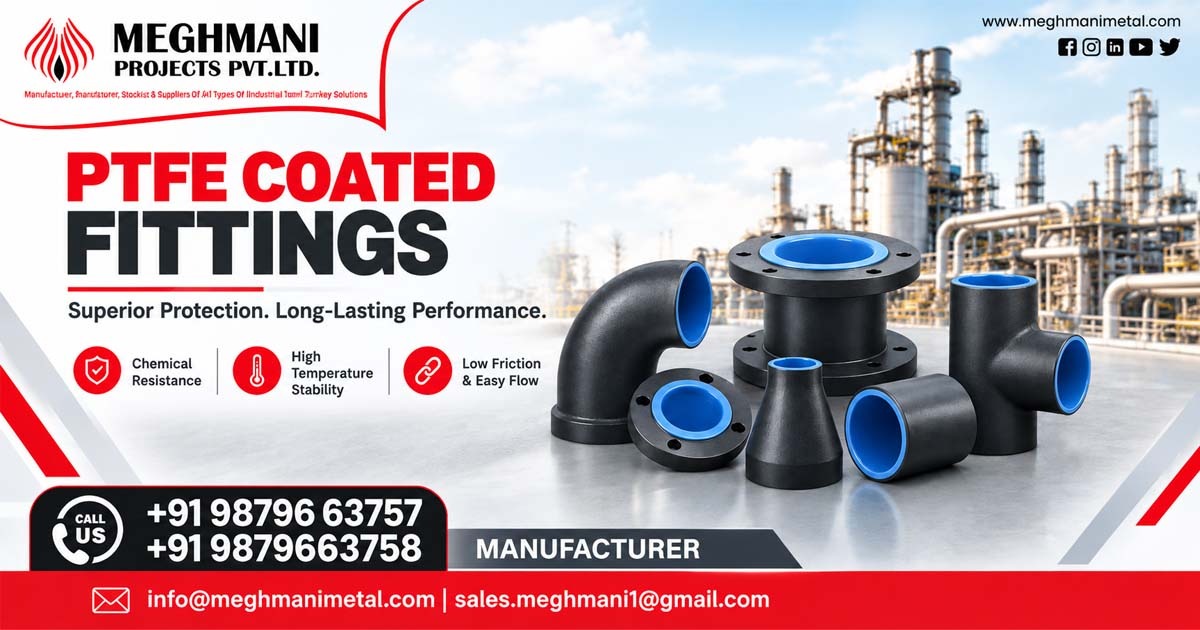
PTFE-coated fittings are used where piping connections need protection against aggressive chemicals and demanding process conditions. For industries operating around Jhagadia, selecting suitable fittings requires attention to coating quality, base material, dimensions, process compatibility, and installation requirements.
Why PTFE Coating Matters in Process Piping
PTFE coating provides a chemically resistant surface over the fitting. It can be relevant in piping systems handling corrosive or reactive process media where direct exposure of the underlying metal needs to be controlled.
- Process fluid and its concentration
- Operating temperature
- Pressure conditions
- Connection type
- Required dimensions
- Installation environment
- Cleaning and maintenance practices
The right choice depends mainly on the actual process conditions rather than the coating name alone.
Check These Factors Before Ordering
When comparing a PTFE coated fittings supplier in Jhagadia, buyers should prepare the application details before requesting a quotation.
| Buyer Check | Why It Matters |
| Fitting type | Ensures the connection matches the piping layout |
| Base material | Determines mechanical suitability and process compatibility |
| PTFE coating | Needs to suit the intended chemical environment |
| Size and dimensions | Prevents installation and connection problems |
| Temperature | Helps confirm suitability for operating conditions |
| Pressure | Supports appropriate fitting selection |
| Connection details | Ensures compatibility with existing piping |
| Quantity | Helps suppliers plan production and supply |
| Custom requirements | Useful for non-standard process arrangements |
Providing drawings, dimensions, fluid details, and operating conditions can make technical discussions more precise.
Where These Fittings Fit Into Industrial Piping
PTFE-coated fittings can be considered for process piping environments where corrosion resistance is an important requirement. Their suitability depends on the specific chemical service and operating conditions.
They may be relevant to:
- Chemical processing facilities
- Pharmaceutical process systems
- Specialty chemical plants
- Industrial water-treatment systems
- Chemical storage and transfer arrangements
- Manufacturing units using corrosive process fluids
The fitting type should be selected according to the actual connection point rather than choosing one standard configuration for every application.
Installation Details That Deserve Attention
A correctly selected fitting can still create problems if installation is poorly planned. Before installation, check the mating connections, dimensions, alignment, and accessibility.
During installation:
- Confirm the fitting size and connection type.
- Inspect the PTFE-coated surface for visible damage.
- Keep sealing surfaces clean.
- Align connected piping without forcing the fitting into position.
- Tighten connections according to the applicable installation practice.
- Inspect the completed assembly before introducing process fluid.
Avoid using damaged or visibly compromised coated components without technical assessment.
Maintenance Starts With Regular Inspection
Maintenance requirements depend on the process and installation conditions. Routine inspection should focus on areas where leakage, mechanical stress, or coating damage could develop.
Check for:
- Leakage around joints
- Visible coating damage
- Loose connections
- Corrosion around exposed areas
- Pipe misalignment or excessive mechanical loading
- Changes in operating conditions
Cleaning methods should be compatible with both the PTFE surface and the underlying fitting. Manufacturer recommendations should be followed where specific procedures are required.
Simple Troubleshooting for Piping Problems
| Observed Issue | Possible Cause | Practical Check |
| Leakage at connection | Incorrect assembly or sealing issue | Inspect joint alignment and sealing arrangement |
| Visible coating damage | Mechanical handling or process exposure | Inspect affected surface and review service conditions |
| Premature fitting deterioration | Unsuitable process conditions | Verify chemical, temperature and pressure conditions |
| Difficult installation | Dimensional mismatch | Recheck fitting and mating-pipe dimensions |
| Repeated joint problems | Pipe stress or misalignment | Check the surrounding piping arrangement |
What to Verify From a Supplier
Confirm:
- Exact fitting type and dimensions
- Base material
- PTFE coating details relevant to the application
- Connection configuration
- Quantity and packing requirements
- Inspection or testing documentation, where applicable
- Drawing approval for customized items
- Installation and technical guidance
- Spare or replacement availability
- Expected delivery requirements
A supplier should be able to understand the application instead of quoting only from a product name.
Services
- Application-based fitting selection and requirement discussion
- Dimensional and configuration review for piping requirements
- Support for customized or project-specific fitting requirements
- Technical assistance related to installation and product selection
Location
Jhagadia is an important industrial area in Gujarat, making suitable corrosion-resistant piping components relevant to chemical, pharmaceutical, manufacturing, and process industries in and around the region. Buyers can also source according to nearby industrial requirements across Bharuch, Ankleshwar, Dahej, Panoli, Vagra, Valia, Hansot, Jambusar, Palej, Karjan, Vadodara, Halol, Savli, Padra, Surat, Hazira, Sachin, Palsana, Kim, Kosamba, and Ahmedabad.
Industrial Requirement Support From Meghmani Projects
For buyers evaluating a PTFE coated fittings supplier in Jhagadia, Meghmani Projects Pvt. Ltd. can discuss the requirement based on fitting type, dimensions, application conditions, and project needs. The company provides manufacturing support from Ahmedabad, Gujarat, India, with product-related consultation and technical assistance.
Visit Meghmani Projects Pvt. Ltd. to discuss the fitting requirement and determine a suitable configuration for the intended piping system.
Frequently Asked Questions
Q: What information should I provide when requesting PTFE-coated fittings?
A: Provide the fitting type, size, connection details, base material, process fluid, operating temperature, pressure, quantity, and any available drawings or specifications.
Q: Is PTFE coating suitable for every chemical application?
A: No. Suitability depends on the chemical, concentration, temperature, pressure, and operating conditions. The complete application should be reviewed before ordering.
Q: Can PTFE-coated fittings be customized?
A: Customization may be possible depending on the fitting design and project requirement. Discuss dimensions, connection configuration, and drawings with the supplier before production.
Q: What should be inspected after installation?
A: Check alignment, connections, sealing arrangements, visible coating condition, and leakage before putting the piping system into normal service.
Conclusion
For industrial buyers in Jhagadia, PTFE-coated fittings should be selected by considering chemical compatibility, fitting dimensions, base material, operating conditions, and installation requirements together. Proper supplier evaluation can also simplify technical coordination. Meghmani Projects Pvt. Ltd. provides manufacturing support from Ahmedabad for relevant industrial fitting requirements.
Contact Meghmani Projects Pvt. Ltd. to discuss your fitting specifications, application requirements, and project planning needs.
Call Us:
Sales: (+91) 98 79 663757
Support: (+91) 98 79 663758
Email Us:
Sales: sales.meghmani11@gmail.com
General: info@meghmanimetal.com
If you have any more questions or customized solutions, please feel free to contact us.