Industrial piping networks require reliable connections to maintain proper flow, pressure handling, and operational safety. Industrial Stainless Steel Buttweld Fittings for Piping Systems help connect, redirect, and branch pipelines across industries. Meghmani Projects Pvt. Ltd. provides manufacturing support from Ahmedabad, Gujarat, India.
Understanding the Role of Buttweld Fittings in Industrial Pipelines
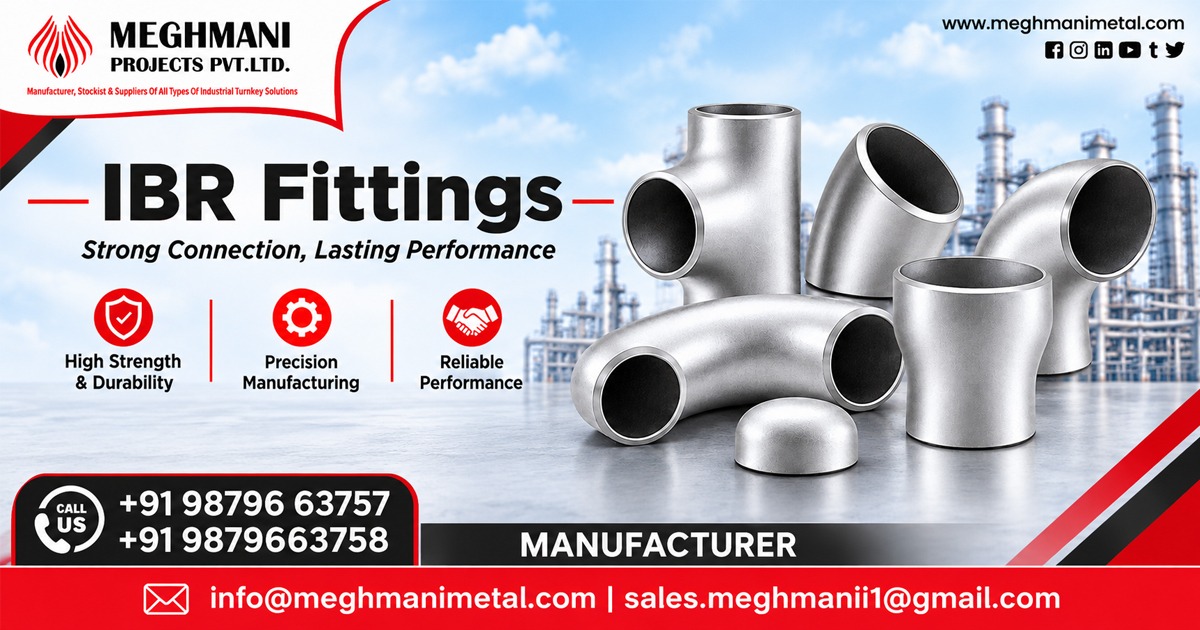
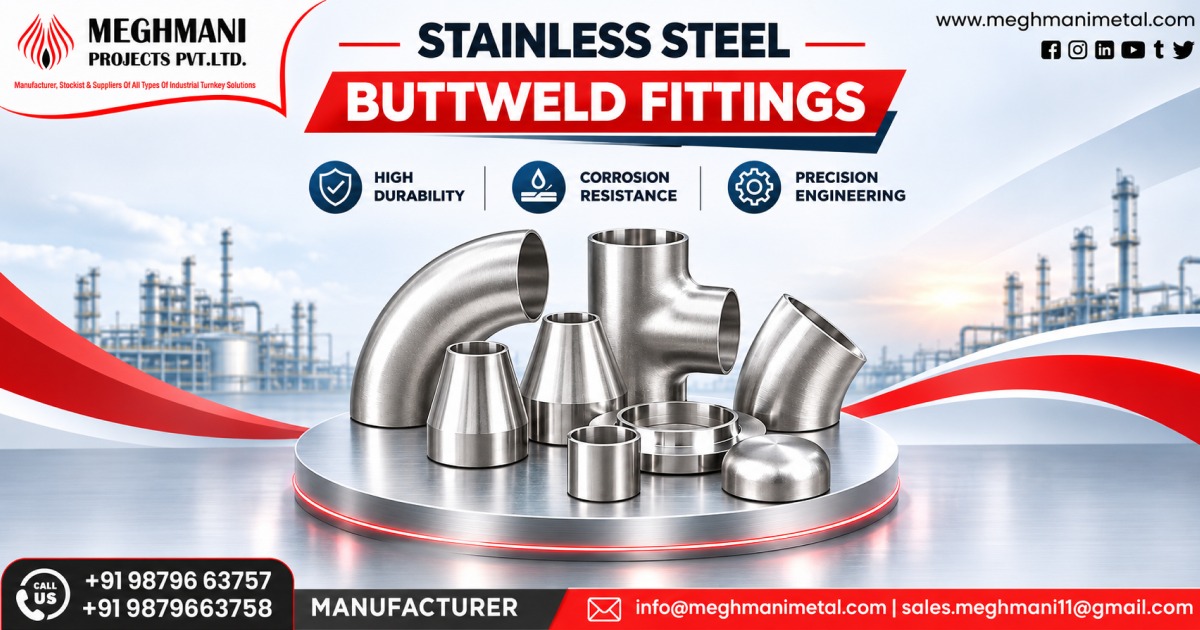
Stainless steel buttweld fittings are pipe components designed to connect two pipeline sections through a welded joint. They help create a continuous piping network while maintaining a strong connection between adjoining pipes.
Unlike threaded or socket-weld connections, buttweld fittings are joined directly to pipes through a butt-welding process.
These components are commonly selected when industrial piping requires:
- Permanent connections between pipeline sections.
- Changes in flow direction using elbows.
- Branch connections through tees.
- Pipeline size transitions using reducers.
- Closure of unused pipeline ends with end caps.
- Connections suitable for demanding process environments.
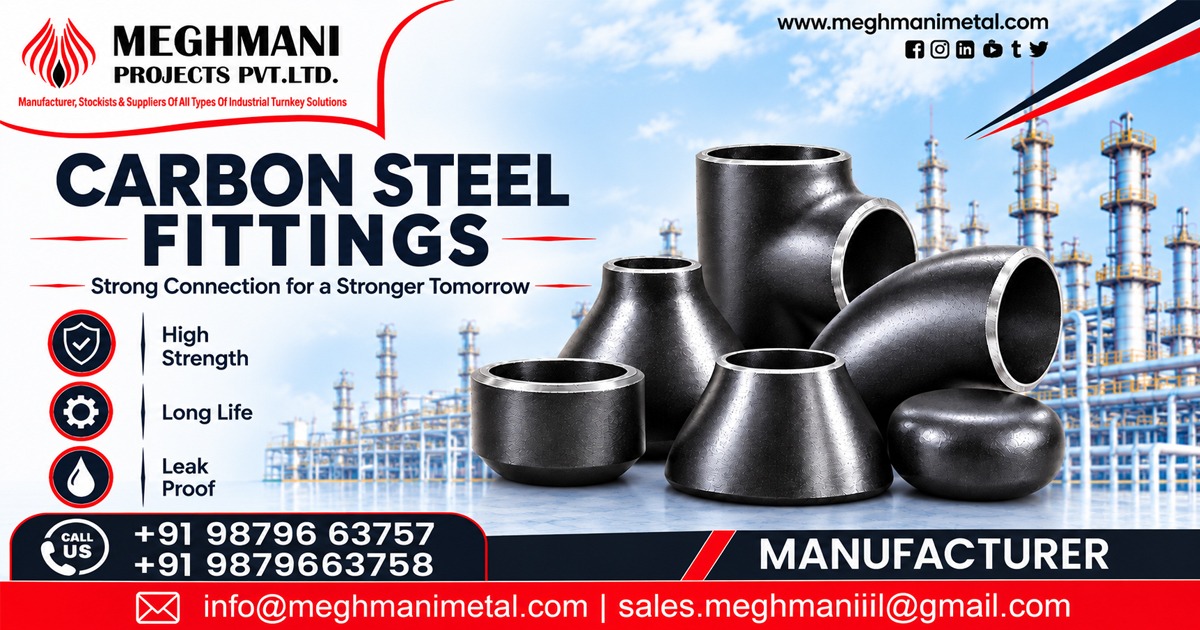
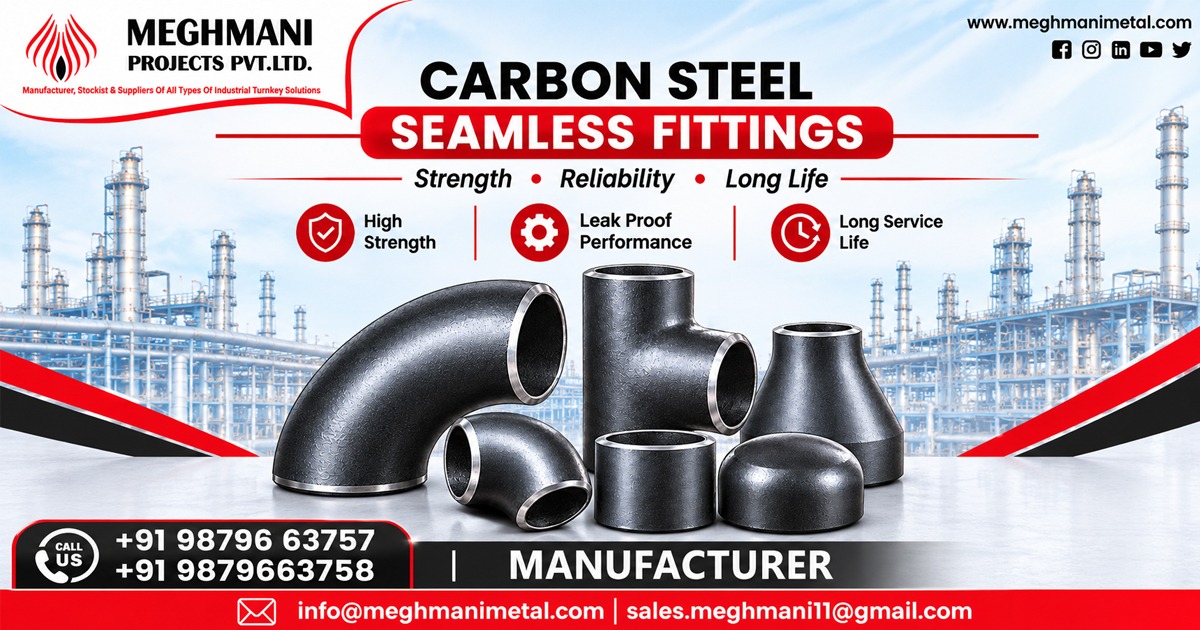
Common types of stainless steel buttweld fittings include:
| Fitting Type | Primary Function |
| 45° Elbow | Changes pipeline direction by 45 degrees |
| 90° Elbow | Changes pipeline direction by 90 degrees |
| Equal Tee | Creates a branch with the same pipe size |
| Reducing Tee | Creates a smaller branch connection |
| Concentric Reducer | Connects pipes of different diameters with a common centreline |
| Eccentric Reducer | Connects different pipe sizes with an offset arrangement |
| End Cap | Closes the end of a pipeline |
The correct fitting depends on pipeline design, fluid characteristics, operating conditions, and installation requirements.
What Should Buyers Check Before Selecting Stainless Steel Fittings?
Selecting the wrong fitting can create alignment difficulties, welding problems, leakage risks, and unnecessary maintenance requirements.
Before purchasing Industrial Stainless Steel Buttweld Fittings for Piping Systems, consider these important factors:
1. Stainless Steel Grade
- SS 304: Commonly considered for general industrial and processing environments.
- SS 304L: Often selected where lower carbon content is required for welding considerations.
- SS 316: Considered for applications requiring improved corrosion resistance.
- SS 316L: Used where lower carbon content and corrosion resistance are important.
The final grade should be selected according to the process fluid and operating environment.
2. Pipe Diameter and Wall Thickness
Check the following details:
- Nominal pipe size (NPS).
- Outside diameter.
- Schedule or wall thickness.
- Fitting end dimensions.
- Compatibility with the connecting pipe.
3. Fitting Configuration
Identify whether the project requires elbows, tees, reducers, crosses, or end caps. Incorrect fitting geometry can affect pipeline routing and available installation space.
4. Operating Conditions
Evaluate:
- Working pressure.
- Operating temperature.
- Fluid composition.
- Corrosion exposure.
- Flow requirements.
5. Project Compatibility
Confirm that the selected fittings match the piping drawings, welding procedure, and applicable project specifications.
How Buttweld Fittings Become Part of a Piping Network
Understanding the installation sequence helps buyers coordinate fitting selection with pipeline fabrication and site activities.
Step 1: Pipeline Measurement
Measure the pipe diameter, wall thickness, connection points, and required direction changes before selecting the fitting.
Step 2: Fitting Alignment
Position the elbow, tee, reducer, or other fitting between the connecting pipe sections. Check alignment to avoid unnecessary stress on the joint.
Step 3: Edge Preparation and Welding
Prepare the pipe and fitting ends according to the specified welding procedure. Complete the butt weld using an appropriate qualified welding process.
Step 4: Inspection and Testing
Inspect the completed joints for visible defects, dimensional alignment, and weld quality. Conduct applicable non-destructive examination or pressure testing as required by the project specification.
Step 5: Pipeline Commissioning
After completing the required inspections and approvals, prepare the pipeline for commissioning according to the system’s operating procedure.
Quality Checks That Matter Before Ordering
Product appearance alone cannot establish whether a fitting is suitable for industrial service. Buyers should verify important technical details before confirming the purchase.
| Inspection Point | What to Verify |
| Material grade | Confirm the specified stainless steel grade |
| Dimensions | Check diameter, thickness, and fitting geometry |
| Surface condition | Look for cracks, dents, and visible defects |
| End preparation | Verify bevel and welding-end suitability |
| Manufacturing consistency | Check dimensional uniformity across the supplied batch |
| Traceability | Request material identification and available test documentation |
| Application suitability | Match the product with operating conditions |
| Quantity and delivery | Confirm sizes, quantities, and delivery schedule |
Important purchasing consideration: Request the relevant material test certificates, inspection reports, and dimensional details wherever they are required by the project.
Installation and Maintenance: Avoiding Common Pipeline Problems
Even correctly selected fittings require proper installation and inspection to maintain pipeline reliability.
During installation:
- Ensure correct pipe-to-fitting alignment.
- Follow the approved welding procedure.
- Avoid excessive force during fitting adjustment.
- Maintain proper access for welding and inspection.
- Follow project-specific cleaning and passivation requirements where applicable.
During maintenance:
- Inspect accessible welded joints periodically.
- Look for corrosion, leakage, or surface damage.
- Investigate unusual vibration or pipeline movement.
- Check supports and restraints around pipeline connections.
- Follow the plant’s inspection and maintenance schedule.
Common issues to investigate:
- Leakage around welded joints.
- Misalignment between adjoining pipes.
- Corrosion caused by unsuitable material selection.
- Weld defects resulting from improper fabrication.
- Stress caused by inadequate pipeline support.
Addressing these issues early can help prevent avoidable pipeline interruptions.
Services
- Product Requirement Consultation: Assistance in identifying suitable buttweld fitting types, sizes, and material requirements.
- Technical Product Coordination: Support in matching fitting dimensions and configurations with piping project specifications.
- Order and Supply Coordination: Assistance with product identification, quantity planning, and procurement requirements.
- Project Requirement Assistance: Coordination regarding product documentation, delivery planning, and technical requirements.
Location – Industrial Stainless Steel Fittings in Gujarat
Industrial Stainless Steel Buttweld Fittings for Piping Systems are relevant to chemical plants, pharmaceutical facilities, engineering companies, refineries, and process industries throughout Gujarat. Manufacturing support from Ahmedabad, Gujarat, India, can serve project requirements across Ahmedabad, Surat, Vadodara, Rajkot, Gandhinagar, Bharuch, Ankleshwar, Vapi, Valsad, Mehsana, Morbi, Jamnagar, Bhavnagar, Junagadh, Kutch, Mundra, Dahej, Sanand, Halol, Savli, Kalol, and Changodar.
Why Choose Meghmani Projects Pvt. Ltd.?
Choosing the right industrial fitting supplier involves more than comparing product prices. Buyers need clarity about material grades, fitting dimensions, application requirements, and order specifications.
Meghmani Projects Pvt. Ltd. supports industrial procurement requirements through:
- Understanding project-specific piping requirements.
- Coordinating suitable product selection based on technical specifications.
- Supporting manufacturing and procurement coordination.
- Assisting with product-related and project documentation requirements.
With manufacturing support from Ahmedabad, Gujarat, India, the company can coordinate with buyers looking for stainless steel piping components for industrial projects.
Visit the official website: Meghmani Projects Pvt. Ltd.
Frequently Asked Questions (FAQs)
Q1. What are stainless steel buttweld fittings used for?
A: They connect pipeline sections, change flow direction, create branch connections, and connect pipes of different diameters. They are commonly used in industrial fluid transportation systems.
Q2. Which stainless steel grade is suitable for buttweld fittings?
A: SS 304, SS 304L, SS 316, and SS 316L are common options. The right grade depends on fluid composition, temperature, corrosion exposure, and welding requirements.
Q3. How do I select the correct size of a buttweld fitting?
A: Match the fitting’s nominal pipe size, outside diameter, wall thickness, and end configuration with the connecting pipeline. Always check the approved piping specifications.
Q4. What should I inspect before installing stainless steel buttweld fittings?
A: Check material identification, dimensions, surface condition, end preparation, and fitting alignment. Ensure welding and inspection follow the approved project procedures.
Conclusion
Reliable pipeline connections begin with suitable fitting selection and proper fabrication. Industrial Stainless Steel Buttweld Fittings for Piping Systems should match material requirements, dimensions, fluid conditions, and operating pressure. Buyers across Gujarat can coordinate their project requirements with Meghmani Projects Pvt. Ltd. and its manufacturing support from Ahmedabad.
Looking for stainless steel buttweld fittings for your industrial piping project? Contact Meghmani Projects Pvt. Ltd. to discuss product requirements, material selection, and technical specifications.
Call Us:
Sales: (+91) 98 79 663757
Support: (+91) 98 79 663758
Email Us:
Sales: sales.meghmani11@gmail.com
General: info@meghmanimetal.com
If you have any more questions or customized solutions, please feel free to contact us.