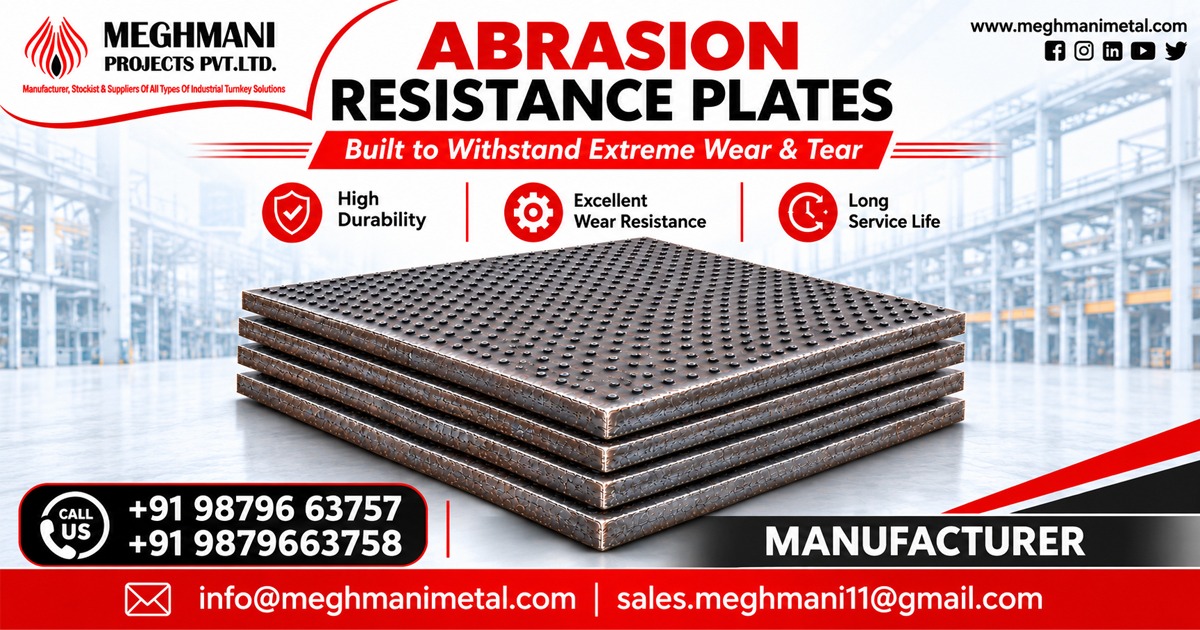
Industrial equipment handling abrasive materials can experience surface wear, frequent part replacement, and production interruptions. Abrasion-resistant plates help protect critical components, while Meghmani Projects Pvt. Ltd. supports industrial requirements in Gurugram.
What Makes an Abrasion-Resistant Plate Suitable for Heavy-Wear Conditions?
Abrasion-resistant plates, also called AR plates or wear-resistant steel plates, are designed to withstand surface wear caused by friction, sliding particles, and repeated material contact.
They are commonly considered for equipment exposed to:
- Coal, mineral, and ore movement.
- Sand, gravel, and aggregate handling.
- Cement and clinker processing.
- Material transfer through hoppers and chutes.
- Mining and earthmoving operations.
- Industrial recycling and bulk material handling.
The main purpose: Protect equipment surfaces from excessive material loss and reduce the frequency of wear-related component replacement.
Understanding the Different Types of Wear
| Wear condition | What happens | Selection consideration |
| Sliding abrasion | Particles continuously move across the plate | Surface hardness |
| Impact abrasion | Materials repeatedly strike the surface | Hardness and toughness |
| Gouging abrasion | Large, sharp particles cut into the surface | Wear resistance and impact strength |
A plate suitable for sliding sand may not perform equally well in a crusher handling large stones. The operating environment should determine the material specification.
How Wear-Resistant Plates Protect Industrial Equipment
In material-handling equipment, abrasive particles gradually remove material from exposed surfaces. Once the plate becomes thinner, equipment components may require repair or replacement.
Abrasion-resistant steel provides a harder working surface to help control this wear.
Typical installation locations include:
- Hoppers: Protecting internal surfaces where bulk materials collect and move.
- Transfer chutes: Reducing wear at material impact and sliding zones.
- Conveyor systems: Protecting selected transfer points and liners.
- Crusher equipment: Supporting wear protection in suitable impact zones.
- Dump truck bodies: Protecting surfaces exposed to repeated loading and unloading.
- Mining machinery: Providing wear-resistant surfaces in buckets and material-handling components.
The plate should be treated as part of the equipment’s wear-management design rather than as a simple replacement sheet.
Selecting the Right Plate Grade for Gurugram Industrial Projects
One of the most important purchasing decisions is matching plate hardness with the actual operating conditions. A higher hardness value does not automatically mean better performance in every application.
Consider these technical points before finalising an order:
1. Hardness requirement: Evaluate the required Brinell hardness based on the material being handled and the expected abrasion.
2. Impact conditions: Equipment exposed to heavy stone impact needs an appropriate balance between hardness and toughness.
3. Plate thickness: Consider expected wear, structural loading, support arrangements, and replacement requirements.
4. Material characteristics: Particle size, shape, moisture, and abrasiveness influence surface wear.
5. Fabrication requirements: Check whether the plate needs cutting, drilling, bending, or welding.
6. Equipment compatibility: Confirm dimensions, mounting arrangements, and the existing liner design.
7. Operating environment: Consider temperature, exposure to moisture, and possible corrosive conditions alongside abrasion.
For example, a cement plant handling fine abrasive material may require a different plate specification from a mining operation exposed to large angular rocks.
Installation Planning: From Plate Dimensions to Equipment Fitment
Correct installation helps the wear plate perform as intended. Before dispatching material for fabrication or site installation, review the equipment layout and mounting requirements.
Pre-installation checks
- Measure the existing liner or plate area accurately.
- Confirm thickness, width, length, and cutting dimensions.
- Inspect the supporting structure for damage or deformation.
- Identify bolt holes, weld locations, and mounting arrangements.
- Check access for installation and future replacement.
- Ensure the replacement plate does not obstruct material flow.
Installation and commissioning sequence
- Site inspection: Review the equipment and identify the sections requiring wear protection.
- Dimension confirmation: Match plate dimensions with approved drawings.
- Fabrication: Complete cutting, drilling, or edge preparation according to the material specification.
- Fitment: Install using an appropriate fastening or welding method recommended for the selected grade.
- Final inspection: Check alignment, support, joints, and clearances.
- Trial operation: Observe material movement and inspect for unusual impact, vibration, or loose connections.
Welding and cutting procedures should follow the plate manufacturer’s recommendations. Incorrect heat input or unsuitable fabrication methods can affect the material’s properties.
Maintenance Practices That Help Control Plate Wear
Even wear-resistant materials require periodic inspection. Maintenance teams should monitor the actual condition of plates rather than waiting until equipment performance is affected.
Recommended inspection activities:
- Check frequently exposed areas for uneven surface wear.
- Inspect joints, fasteners, and welded connections.
- Look for cracks, deformation, or localised material loss.
- Remove accumulated material where it affects equipment movement.
- Compare worn sections with their original thickness.
- Plan replacement before the plate becomes unsuitable for continued service.
Common Wear-Related Problems and Corrective Actions
| Observed issue | Possible reason | Practical action |
| Rapid surface thinning | Incorrect grade or severe abrasion | Review wear conditions and material selection |
| Cracks near joints | Impact stress or unsuitable fabrication | Inspect installation and fabrication methods |
| Uneven wear | Concentrated material flow | Review chute or equipment geometry |
| Plate deformation | Excessive impact or inadequate support | Check structural support and loading |
| Loose mounting | Fastener or joint problems | Inspect and secure the mounting arrangement |
Maintenance frequency should depend on material characteristics, operating hours, and actual wear observations.
What Buyers Should Verify Before Placing a Bulk Order
A clear purchase specification helps avoid material mismatches, fabrication delays, and installation problems.
Use this checklist when evaluating an abrasion-resistant plate supplier:
| Checkpoint | Information to confirm |
| Grade | Required AR grade or manufacturer designation |
| Hardness | Specified Brinell hardness range |
| Dimensions | Thickness, width, and length |
| Material condition | Supplied material condition and relevant technical details |
| Testing | Hardness and impact test requirements, where applicable |
| Documentation | Material test certificates and traceability, where agreed |
| Fabrication | Cutting, drilling, bending, or welding requirements |
| Quantity | Individual plate count and total requirement |
| Delivery | Dispatch schedule and transportation arrangements |
| Support | Technical coordination and replacement planning |
Buyers should also request clarification about the relationship between plate thickness and the specified hardness range.
For example, AR400, AR450, and AR500 are commonly used commercial hardness designations, but the exact properties must be checked against the manufacturer’s material documentation. Hardness alone does not establish suitability for every application.
Services
- Material Selection Assistance: Guidance on assessing plate grades, thickness, hardness, and application requirements.
- Requirement Assessment: Coordination for dimensions, quantities, and project-specific material specifications.
- Supply and Fabrication Coordination: Assistance with discussing material availability and required plate processing.
- Technical Requirement Support: Coordination regarding installation considerations, documentation, and maintenance planning.
How Meghmani Projects Pvt. Ltd. Supports Industrial Procurement
Industrial buyers often need more than a material quotation. They also need clarity about specifications, dimensions, material suitability, and supply coordination.
Meghmani Projects Pvt. Ltd. is an Ahmedabad-based engineering and metal products company supporting industrial material requirements.
For buyers evaluating an Abrasion Resistance Plates Supplier In Gurugram, the company can assist with discussing application requirements, reviewing technical specifications, and coordinating suitable material options.
Its website, meghmanimetal.com, provides information about its industrial metal product range, including sheets, plates, coils, bars, rods, pipes, tubes, and other metal products.
The company has manufacturing support from Ahmedabad, Gujarat, India. Its team can be approached to confirm the availability, grade, dimensions, and supply suitability of abrasion-resistant plates for a particular project.
Since abrasion-resistant plate grades are application-specific, buyers should confirm the exact product range and technical documentation before finalising their purchase.
Location: Gurugram and Nearby Industrial Areas
Gurugram has a strong industrial and commercial ecosystem, including automotive manufacturing, engineering, warehousing, logistics, fabrication, and material-handling operations. These industries may require wear-resistant plates for equipment exposed to continuous friction and abrasive materials. Meghmani Projects Pvt. Ltd. provides manufacturing support from Ahmedabad, Gujarat, India, for industrial procurement requirements in this region.
Major industrial and commercial locations: Gurugram, Udyog Vihar, IMT Manesar, Sector 18, Sector 32, Sector 34, Sector 37, Sector 44, Sector 45, Sector 48, Sector 53, Sector 57, Sector 74, Sector 75, Sector 76, Sohna, Sohna Road, Pataudi, Bilaspur, Farrukhnagar, Kadipur, Bawal, Dharuhera, Rewari.
Frequently Asked Questions
Q1. Which hardness grade should be selected for abrasion-resistant plates?
A: The selection depends on the type of abrasion, impact intensity, and material being handled. Common commercial grades include AR400, AR450, and AR500, but the manufacturer’s technical specifications should guide the final decision.
Q2. Can abrasion-resistant plates be cut and welded?
A: Yes, suitable grades can be processed using recommended fabrication methods. Cutting, drilling, and welding procedures should follow the manufacturer’s guidelines to avoid affecting material properties.
Q3. How can buyers estimate the required plate thickness?
A: Consider equipment loading, expected wear, structural support, and replacement requirements. Reviewing existing wear patterns can help determine an appropriate thickness.
Q4. What documents should be requested when purchasing wear-resistant plates?
A: Buyers can request material test certificates, grade identification, hardness details, dimensional information, and applicable inspection reports according to the purchase specification.
Conclusion
Selecting the right Abrasion Resistance Plates Supplier In Gurugram involves understanding material movement, wear intensity, impact conditions, and fabrication requirements. Proper grade selection and regular inspection help manage equipment wear. Meghmani Projects Pvt. Ltd. offers manufacturing support from Ahmedabad, Gujarat, India, for industrial material procurement discussions.
Contact Meghmani Projects Pvt. Ltd. to discuss your abrasion-resistant plate requirements, technical specifications, and industrial supply needs.
Call Us:
Sales: (+91) 98 79 663757
Support: (+91) 98 79 663758
Email Us:
Sales: sales.meghmani11@gmail.com
General: info@meghmanimetal.com
If you have any more questions or customized solutions, please feel free to contact us.