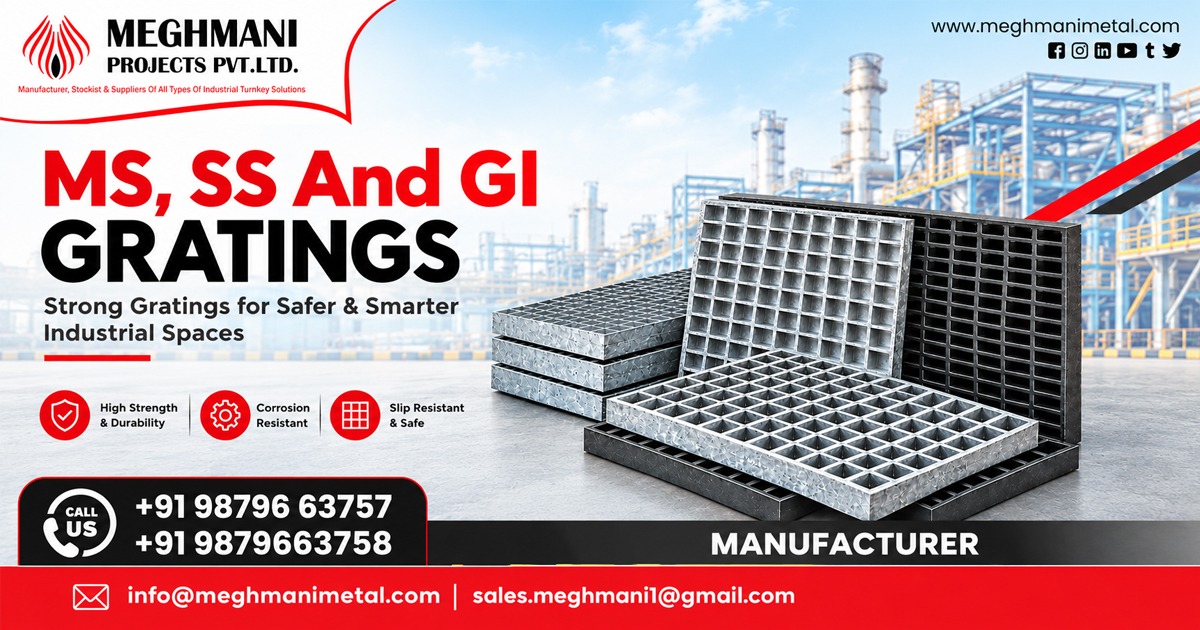
Industries in Kota need gratings that provide safe access, reliable drainage, and suitable load support. Choosing the right material and design helps reduce maintenance issues. Meghmani Projects Pvt. Ltd. supports industrial grating requirements with manufacturing support from Ahmedabad, Gujarat, India.
Understanding MS, SS and GI Gratings for Industrial Projects
Metal gratings are constructed with regularly spaced bars or openings to provide a functional surface for walking, drainage, ventilation, or equipment access. The right option depends on the installation environment, expected load, and exposure to moisture or chemicals.
The three common material options serve different requirements:
- MS (Mild Steel) Gratings: Suitable for many industrial floors, platforms, walkways, maintenance areas, and structural access points where strength and load capacity are important.
- SS (Stainless Steel) Gratings: Considered for environments requiring corrosion resistance, hygiene, or frequent cleaning, depending on the stainless steel grade and operating conditions.
- GI (Galvanized Iron/Steel) Gratings: Steel gratings with a zinc coating that helps protect against corrosion in suitable indoor and outdoor environments.
For industrial buyers seeking an MS, SS and GI gratings supplier in Kota, understanding these material differences is an important first step toward selecting a practical solution.
How to Choose the Right Grating for Your Site
Selecting a grating involves more than comparing prices or dimensions. The product must suit its intended use and installation conditions.
| Selection factor | What buyers should check |
| Load requirements | Consider pedestrian traffic, equipment loads, and vehicle movement where applicable. |
| Material | Match mild steel, stainless steel, or galvanized steel to the operating environment. |
| Opening size | Ensure openings suit drainage needs and applicable personnel safety requirements. |
| Panel dimensions | Confirm length, width, thickness, and support spacing before ordering. |
| Surface finish | Assess whether a plain or slip-resistant surface is appropriate. |
| Corrosion exposure | Consider rain, humidity, chemicals, cleaning agents, and other environmental conditions. |
| Installation method | Check whether panels require bolting, welding, framing, or removable access. |
| Maintenance | Evaluate cleaning access, coating condition, inspection frequency, and replacement needs. |
Practical tip: Share the application, panel dimensions, support arrangement, and expected load with the supplier before finalizing the order. These details help avoid unsuitable panel selection and installation delays.
How Metal Gratings Are Installed and Put Into Service
A suitable grating must be installed correctly to perform as intended. The process generally involves four stages.
Step 1: Inspect the Installation Area
Measure the opening, supporting beams, and panel seating surfaces. Check the site drawings and identify any drainage, access, or clearance requirements.
Step 2: Confirm Panel Dimensions and Load Suitability
Verify that the selected panels match the required dimensions and design loads. The supporting structure must also be suitable for the anticipated loading conditions.
Step 3: Position and Secure the Panels
Place the panels on their designated supports and secure them using the specified fixing method. Avoid unsupported edges, loose panels, and uneven seating.
Step 4: Inspect Before Regular Use
Check panel stability, fixing points, surface condition, and alignment. For areas exposed to heavy loads, establish an inspection schedule based on operating conditions.
Proper installation helps reduce movement, excessive vibration, and premature damage during service.
Quality Checks Buyers Should Complete Before Ordering
Before purchasing industrial gratings, buyers should confirm that the supplied product matches the approved requirement.
Important checks include:
- Material identification: Verify the specified steel type and grade, where applicable.
- Dimensions: Check panel size, bearing bar dimensions, spacing, and overall thickness against the approved drawing.
- Load suitability: Confirm the intended load, support span, and expected usage.
- Surface condition: Inspect for damaged bars, sharp edges, deformation, or coating defects.
- Fabrication consistency: Check welds, joints, panel alignment, and edge finishing as applicable to the design.
- Corrosion protection: For galvanized gratings, examine the coating condition and confirm suitability for the exposure environment.
- Documentation: Request relevant material details, drawings, inspection records, and test documentation where required.
- Delivery planning: Confirm quantities, panel identification, packaging, and delivery schedules before dispatch.
These checks help procurement teams reduce mismatches between the ordered product and actual site requirements.
Custom Dimensions, Site Conditions and Maintenance Planning
Grating requirements often vary between factories, commercial buildings, processing facilities, and infrastructure projects. Panel dimensions, support spacing, surface treatment, and fixing arrangements should therefore be finalized according to the application.
Before placing an order, consider the following:
- For drainage channels: Check flow requirements, opening dimensions, and safe access for cleaning.
- For industrial platforms: Verify load capacity, support spacing, and access requirements for workers.
- For outdoor installations: Assess rain exposure, corrosion risk, and drainage around the supporting structure.
- For hygienic environments: Evaluate the stainless steel grade, surface finish, and cleaning procedures.
- For maintenance access: Determine whether panels need to be removable and how they will be secured during operation.
Routine inspections should look for loose fixings, damaged welds, bent bars, corrosion, and coating deterioration. Any damaged panel should be assessed and repaired or replaced before it creates a safety concern.
Services
- Industrial grating requirement assessment and product selection guidance.
- Assistance with material, dimensions, and application-related specifications.
- Coordination of grating requirements for industrial and infrastructure projects.
- Technical assistance with product suitability and installation-related queries.
Location: Industrial Grating Requirements in Kota, Rajasthan
Kota has industrial, engineering, power, chemical, construction, and infrastructure-related requirements where suitable metal gratings may be needed for platforms, drainage channels, walkways, and access areas. Meghmani Projects Pvt. Ltd. provides manufacturing support from Ahmedabad, Gujarat, India, for buyers evaluating industrial grating requirements in Kota and surrounding markets. Relevant locations across Rajasthan include Kota, Jaipur, Jodhpur, Udaipur, Ajmer, Bikaner, Alwar, Bhilwara, Pali, Sikar, Sri Ganganagar, Bharatpur, Chittorgarh, Kishangarh, Beawar, Barmer, Jaisalmer, Tonk, Bundi, Baran, Jhalawar, Neemrana, Bhiwadi, and the RIICO industrial areas.
Why Consider Meghmani Projects Pvt. Ltd. for Grating Requirements?
Selecting a supplier involves understanding the application, confirming the material, and ensuring that the proposed product matches site requirements. These steps are particularly important when gratings must fit existing structures or meet specific loading conditions.
Meghmani Projects Pvt. Ltd. can be contacted to discuss industrial grating requirements and clarify product selection considerations. With manufacturing support from Ahmedabad, Gujarat, India, the company can be approached for requirement discussions relating to projects in Kota.
Visit the company website at meghmanimetal.com to learn more and discuss your requirements.
Frequently Asked Questions
Q: What is the difference between MS, SS and GI gratings?
A: MS gratings are commonly selected for general structural applications, SS gratings for environments requiring suitable corrosion resistance or hygiene, and GI gratings for applications benefiting from a protective zinc coating.
Q: How do I determine the load capacity of a metal grating?
A: Load capacity depends on the bar dimensions, spacing, panel span, material, and support arrangement. Share the intended load and installation details with a qualified supplier or engineer before ordering.
Q: Are galvanized gratings suitable for outdoor installations?
A: They can be suitable for many outdoor applications, depending on the coating quality and environmental exposure. Highly corrosive environments may require a different material or protection strategy.
Q: What information should I provide when requesting a grating quotation?
A: Provide the material preference, panel dimensions, quantity, intended application, expected load, support spacing, surface finish, and delivery location. Drawings or photographs of the installation area can also help clarify requirements.
Conclusion
Choosing the right metal grating requires attention to material, load capacity, corrosion exposure, dimensions, and installation conditions. Businesses in Kota can evaluate these factors before purchasing. Meghmani Projects Pvt. Ltd., with manufacturing support from Ahmedabad, Gujarat, India, can be approached to discuss suitable grating requirements for industrial projects.
Contact Meghmani Projects Pvt. Ltd. through meghmanimetal.com to discuss your MS, SS, or GI grating requirements, project dimensions, and product selection needs.
Call Us:
Sales: (+91) 98 79 663757
Support: (+91) 98 79 663758
Email Us:
Sales: sales.meghmani11@gmail.com
General: info@meghmanimetal.com
If you have any more questions or customized solutions, please feel free to contact us.