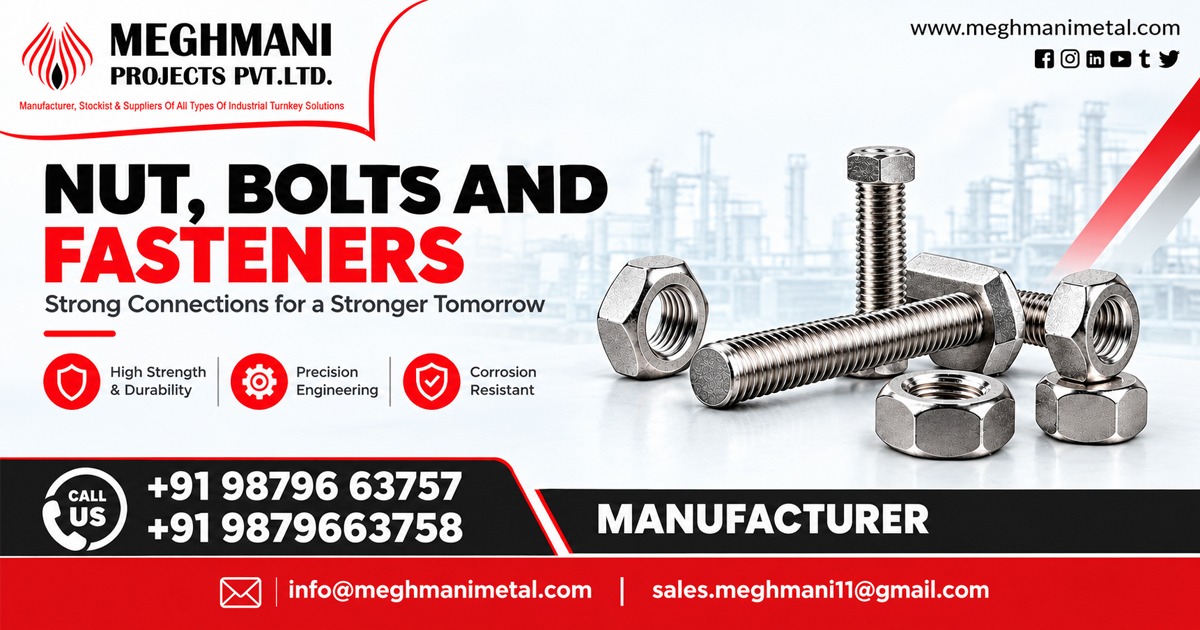
Industrial construction, machinery assembly, and infrastructure projects depend on properly selected fastening components. Finding a reliable Nut, Bolts and Fasteners Supplier In Delhi helps buyers source suitable products for secure connections, consistent assembly, and long-term operational requirements. Meghmani Projects Pvt. Ltd. supports industrial requirements with manufacturing support from Ahmedabad, Gujarat, India.
Understanding Fasteners for Industrial Assembly and Structural Connections
Nuts, bolts, and fasteners are mechanical components used to join two or more parts securely. They help maintain structural stability while allowing components to be assembled, dismantled, inspected, or replaced when required.
Different fastening arrangements are used across industrial and commercial projects, including:
- Hex Bolts: Commonly used for machinery assembly, structural connections, and equipment installation.
- Hex Nuts: Used with compatible threaded bolts to create secure mechanical joints.
- Washers: Help distribute the applied clamping load and protect connected surfaces.
- Threaded Fasteners: Used where specific thread engagement and connection requirements are necessary.
- Industrial Fastening Components: Selected according to mechanical loading, environmental exposure, and assembly conditions.
For businesses sourcing fastening materials in Delhi, choosing the correct combination is important. An unsuitable fastener can lead to loose connections, damaged threads, corrosion, or repeated maintenance.
How to Select Nuts, Bolts and Fasteners for Your Project
Selecting industrial fasteners requires more than comparing dimensions and purchase prices. Buyers should evaluate the complete application before finalising an order.
1. Identify the Material Requirement
Fastener material should match the operating environment.
- Carbon steel for suitable general-purpose applications.
- Stainless steel for environments where corrosion resistance is important.
- Other specified alloys where particular mechanical or environmental requirements apply.
2. Check Dimensions and Thread Compatibility
Verify the following before ordering:
- Nominal diameter and bolt length.
- Thread pitch and thread type.
- Nut dimensions and thread compatibility.
- Washer inner and outer diameters.
- Required tolerances and fitting arrangements.
3. Evaluate Mechanical Requirements
Consider the expected tensile load, shear load, vibration, tightening conditions, and joint design. Fastener grades should be selected according to engineering requirements rather than appearance alone.
4. Consider Environmental Conditions
Outdoor installations, chemical-processing facilities, humid environments, and industrial plants may require different material and surface-finish considerations.
5. Estimate Quantity and Future Requirements
Calculate the total requirement, including installation quantities and maintenance spares. Consistent product specifications across repeat orders can also simplify inventory management.
From Product Identification to Final Installation: How Fasteners Work
A fastening connection works through the interaction of threaded components and the clamping force created during tightening.
Step 1: Identify the Joint
Determine which components need to be connected and understand the required load-bearing conditions.
Step 2: Match the Components
Select a compatible bolt, nut, and washer arrangement based on dimensions, material, thread type, and mechanical requirements.
Step 3: Position and Assemble
Insert the bolt through the prepared holes, position the washer where required, and engage the nut correctly without damaging the threads.
Step 4: Apply the Required Tightening
Use an appropriate tightening method and specified torque wherever engineering requirements define one. Avoid over-tightening, which can damage threads or affect joint performance.
Step 5: Inspect the Connection
Check alignment, thread engagement, seating, and tightening condition. For vibration-sensitive installations, use an appropriate locking arrangement if specified by the design.
Quality Checks Buyers Should Complete Before Ordering
Fastener quality directly influences joint reliability. Industrial buyers should establish clear inspection requirements before accepting a supply.
Important checks include:
| Inspection parameter | What to verify |
| Material | Confirm the specified material grade |
| Dimensions | Check diameter, length, and nut size |
| Thread quality | Inspect thread profile and fitting |
| Surface finish | Check for rust, damage, or coating defects |
| Mechanical grade | Verify the required property class |
| Compatibility | Ensure correct bolt and nut matching |
| Documentation | Request applicable material and test documents |
| Packaging | Check identification, quantity, and product segregation |
For bulk procurement, buyers should also confirm batch identification and consistency between supplied lots.
A properly documented purchase specification reduces the possibility of receiving components that do not match the original engineering requirement.
Preventing Fastener Problems During Installation and Maintenance
Incorrect installation practices can reduce the reliability of otherwise suitable fastening components.
Some common problems include:
- Thread Damage: Usually associated with incorrect engagement, mismatched threads, or excessive tightening.
- Corrosion: Can develop when the selected material or surface protection is unsuitable for the environment.
- Joint Loosening: May occur due to vibration, insufficient preload, or unsuitable locking arrangements.
- Bolt Failure: Can result from incorrect grade selection, excessive loading, or improper installation.
- Uneven Clamping: May develop when tightening is inconsistent across multiple fastening points.
For maintenance teams, periodic inspection should follow the equipment manufacturer’s recommendations and the application’s engineering requirements. Damaged or heavily corroded fasteners should be evaluated and replaced appropriately.
Services
- Industrial nut, bolt, and fastener requirement consultation.
- Product specification and material selection assistance.
- Bulk procurement coordination and order planning.
- Technical assistance for industrial fastening requirements.
Industrial Fastener Requirements Across Delhi and NCR
Manufacturing facilities, construction contractors, infrastructure developers, machinery manufacturers, and maintenance departments across Delhi require fastening components for different operational needs. A suitable Nut, Bolts and Fasteners Supplier In Delhi can help businesses coordinate product specifications and procurement requirements across Delhi and NCR.
Relevant industrial and commercial locations include Connaught Place, Okhla Industrial Area, Naraina Industrial Area, Mayapuri, Wazirpur Industrial Area, Bawana Industrial Area, Narela Industrial Area, Patparganj Industrial Area, Jhilmil Industrial Area, Badli Industrial Area, Kirti Nagar, Anand Parbat, Mundka, Mangolpuri, Lawrence Road, Rohini, Azadpur, Najafgarh, Dwarka, Sahibabad, Noida, Greater Noida, Ghaziabad, Faridabad, and Gurugram.
How Meghmani Projects Pvt. Ltd. Supports Industrial Fastener Procurement
Selecting a fastening supplier involves understanding the actual application, product specifications, and procurement schedule. Meghmani Projects Pvt. Ltd. works with industrial requirements where correct product identification and supply coordination are important.
With manufacturing support from Ahmedabad, Gujarat, India, the company can be approached for discussions related to product requirements, material considerations, dimensions, and project-specific procurement needs.
Buyers can visit Meghmani Projects Pvt. Ltd. to learn more about the company and discuss their industrial metal product requirements.
Frequently Asked Questions
Q1: What should I check before purchasing industrial nuts and bolts?
A: Check material grade, diameter, length, thread pitch, mechanical strength, and surface finish. Also confirm compatibility between the bolt and nut for the intended application.
Q2: Which material is suitable for outdoor fastening applications?
A: Material selection depends on moisture exposure, atmospheric conditions, chemical contact, and expected service life. Stainless steel or suitably protected steel may be considered based on the application.
Q3: How can I prevent industrial fasteners from loosening?
A: Use the specified tightening procedure, correct preload, and suitable locking arrangements where required. Regular inspection is important for connections exposed to vibration.
Q4: Can I purchase nuts, bolts, and fasteners in bulk for industrial projects?
A: Yes, bulk procurement can be planned by defining product dimensions, material grades, quantities, and delivery schedules. Providing a detailed specification helps reduce ordering errors.
Conclusion
Reliable fastening connections begin with correct material selection, compatible dimensions, and proper installation practices. Businesses sourcing industrial fasteners in Delhi should evaluate quality, documentation, and procurement requirements. Meghmani Projects Pvt. Ltd., with manufacturing support from Ahmedabad, Gujarat, India, can assist with relevant industrial product enquiries.
Contact Meghmani Projects Pvt. Ltd. through meghmanimetal.com to discuss your nut, bolt, and industrial fastener requirements.
Call Us:
Sales: (+91) 98 79 663757
Support: (+91) 98 79 663758
Email Us:
Sales: sales.meghmani11@gmail.com
General: info@meghmanimetal.com
If you have any more questions or customized solutions, please feel free to contact us.