
Industrial piping systems require properly matched fittings to manage changes in pipeline direction, branching, and diameter without compromising the intended flow arrangement. Stainless Steel Buttweld Fittings for Industrial Piping Systems In Jhagadia are relevant to projects where permanent welded connections, material compatibility, and accurate fitting dimensions are important.
How Buttweld Fittings Help Maintain Pipeline Continuity
Stainless steel buttweld fittings are components that connect pipe sections through butt-welding. Once welded, the fitting becomes an integral part of the piping network, creating a permanent connection between adjoining sections.
These fittings are useful when pipelines need to change direction, divide into multiple lines, or connect pipes of different diameters.
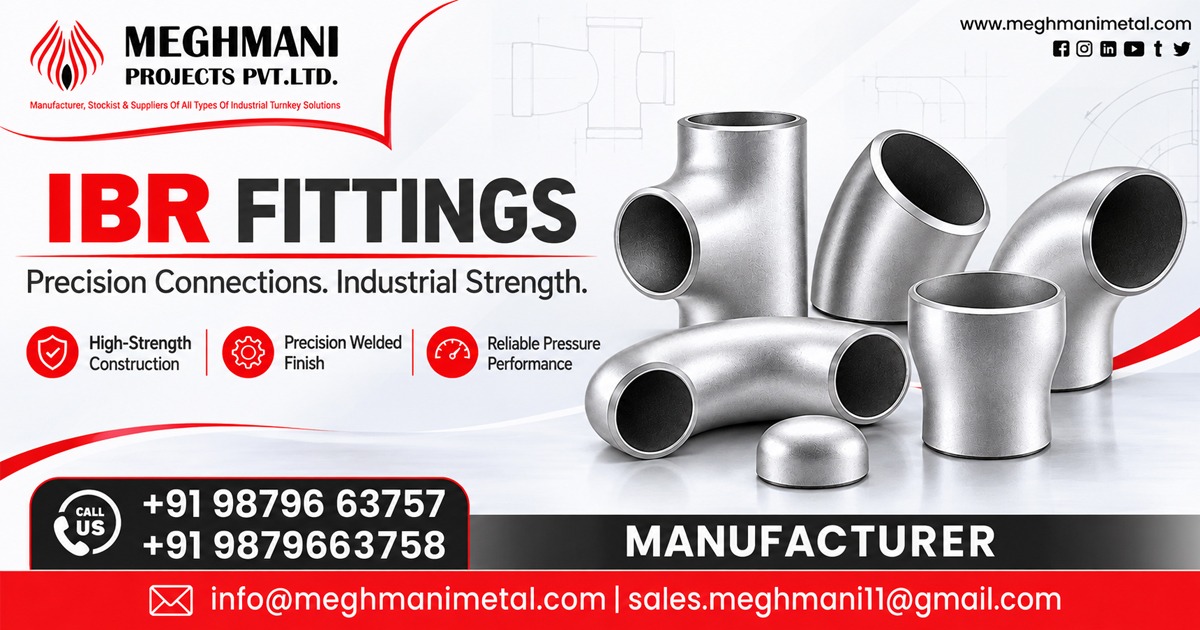
Common fitting configurations include:
- 90° and 45° Elbows: Change pipeline direction according to the plant layout.
- Equal and Reducing Tees: Create branch connections for distributing process fluids.
- Concentric Reducers: Connect different pipe diameters while maintaining a common centreline.
- Eccentric Reducers: Connect different diameters while keeping one side of the pipeline aligned.
- Pipe Caps: Close pipeline ends where a permanent closure is required.
The fitting configuration should be selected according to the piping layout, fluid movement, and available installation space.
Industrial Conditions That Influence Fitting Selection
Jhagadia has an established industrial presence, including chemical and process-related manufacturing activities. In these environments, piping components must be selected according to the actual service conditions rather than appearance or nominal material description alone.
Important operating considerations include:
- Fluid composition: Acids, chemicals, water, and other process media can have different corrosion effects.
- Operating temperature: Temperature influences material suitability and the overall piping design.
- Working pressure: Fitting dimensions, wall thickness, and material must match the system design.
- Welding conditions: Joint preparation and welding procedures influence the quality of the completed connection.
- Cleaning requirements: Chemical cleaning and maintenance procedures should be considered when specifying the material.
For example, a hypothetical chemical processing line handling a chloride-containing fluid may require a different stainless steel grade from a general utility-water pipeline. The correct choice depends on chloride concentration, temperature, exposure conditions, and engineering requirements.
Aligning Fittings with Pipeline Drawings Before Fabrication
A fitting may have the correct nominal diameter but still create problems if its wall thickness, end preparation, or configuration does not match the connecting pipe.
Before fabrication begins, the piping team should compare the fitting details with the approved piping drawings and material specifications.
The installation process generally involves:
- Dimensional verification: Check pipe outside diameter, wall thickness, and fitting dimensions.
- Positioning: Place the fitting according to the required pipeline route and branch arrangement.
- End preparation: Prepare the adjoining ends according to the specified welding-end requirements.
- Welding: Complete the joint using the approved welding procedure and qualified personnel.
- Inspection: Carry out visual inspection and any specified non-destructive examination or pressure testing.
ASME B16.9 is commonly referenced for factory-made wrought buttweld fitting dimensions, while ASME B16.25 covers buttwelding end preparation. The applicable project specification should determine the required standards and editions.
Practical insight: An eccentric reducer and a concentric reducer are not interchangeable in every pipeline arrangement. For example, a horizontal liquid line may require an eccentric reducer to maintain the specified pipe alignment and avoid unwanted high or low points. The engineering drawing should determine the correct arrangement.
Buyer Selection Checkpoints Before Finalising an Order
Industrial buyers should prepare a clear technical enquiry rather than requesting fittings using only the material name.
Consider these five checkpoints:
– Material grade: Specify SS 304, 304L, 316, or 316L according to the fluid, temperature, corrosion exposure, and project requirements.
– Pipe schedule: Confirm the nominal size, outside diameter, and wall thickness of the connecting pipe to avoid mismatched joints.
– Fitting configuration: Mention the required elbow angle, tee arrangement, reducer type, and end-cap dimensions.
– Manufacturing and dimensional standards: Identify the applicable material specification, dimensional standard, and welding-end preparation requirements.
– Inspection documents: Clarify whether material test certificates, heat-number traceability, dimensional inspection, PMI, or additional testing are required.
A purchase enquiry containing these details makes technical evaluation easier and reduces the possibility of receiving components that do not match the piping specification.
Stainless Steel Fitting Requirements and Support from Meghmani Projects
Meghmani Projects Pvt. Ltd. works with industrial product and piping-component requirements. Its website, meghmanimetal.com, lists industrial fittings, SS pipes and tubes, flanges, valves, and other stainless steel product categories.
For buyers evaluating Stainless Steel Buttweld Fittings for Industrial Piping Systems In Jhagadia, the company provides manufacturing support from Ahmedabad, Gujarat, India.
Buyers can discuss the following requirements:
- Product type and fitting configuration.
- Stainless steel grade and material specifications.
- Pipe dimensions and wall thickness.
- Project drawings and technical requirements.
- Documentation and procurement coordination.
Providing the technical details at the enquiry stage helps establish whether the proposed fittings are suitable for the intended application. Buyers can contact Meghmani Projects Pvt. Ltd. through its website to discuss their industrial piping requirements.
Industrial Piping Demand Around Jhagadia, Gujarat
Jhagadia is an important industrial location in Bharuch district, with manufacturing and process-industry activity creating requirements for dependable piping components. Stainless steel fittings are relevant to pipeline fabrication, chemical handling, utility networks, and plant infrastructure.
Manufacturing support from Ahmedabad, Gujarat, India, can address enquiries from Jhagadia and nearby industrial and commercial locations, including:
Jhagadia, Ankleshwar, Bharuch, Dahej, Panoli, Vagra, Vilayat, Palej, Nandesari, Vadodara, Halol, Savli, Karjan, Surat, Hazira, Sachin, Palsana, Kim, Kosamba, Vapi, Valsad, Daman, Silvassa, Sanand, and Ahmedabad.
These locations represent potential industrial procurement markets, not individual company branches or service centres. Buyers should share their project location and delivery requirements when requesting product information.
Frequently Asked Questions
Q1. What is the main purpose of stainless steel buttweld fittings in industrial pipelines?
They connect pipe sections through welded joints and help change pipeline direction, create branches, reduce pipe diameter, or close line ends.
Q2. How do I select between SS 304 and SS 316 buttweld fittings?
The choice depends on the process fluid, operating temperature, corrosion exposure, and engineering specifications. SS 316 may be preferred in certain more corrosive environments, but application-specific evaluation is essential.
Q3. Why should fitting wall thickness match the connecting pipe?
Matching the specified wall thickness helps maintain dimensional compatibility and supports proper welding preparation. Any thickness variation should be evaluated against the approved piping design.
Q4. Can industrial buyers in Jhagadia obtain manufacturing support from Ahmedabad?
Yes. Meghmani Projects Pvt. Ltd. provides manufacturing support from Ahmedabad, Gujarat, India. Buyers can contact the company with their fitting specifications, quantities, and project requirements.
Conclusion
Selecting the right stainless steel fittings requires attention to material grade, pipe dimensions, welding requirements, and operating conditions. For industrial projects in Jhagadia, proper specification checks can reduce fabrication difficulties and procurement errors. Contact Meghmani Projects Pvt. Ltd. to discuss your piping component requirements and manufacturing support from Ahmedabad.
Website: https://meghmanimetal.com/home/
Call Us:
Sales: (+91) 98 79 663757
Support: (+91) 98 79 663758
Email Us:
Sales: sales.meghmani11@gmail.com
General: info@meghmanimetal.com