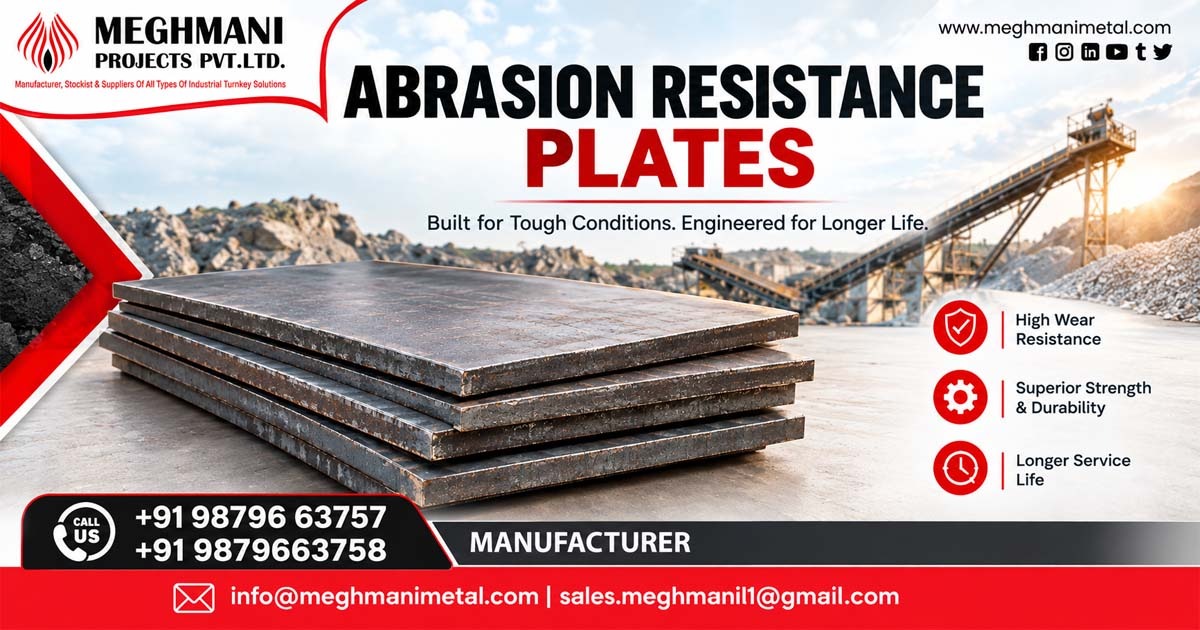
Abrasion resistance plates are used where repeated material contact can wear ordinary steel surfaces. For plants around Ankleshwar, selecting the right plate requires attention to material flow, impact, thickness, fabrication needs, and long-term maintenance.
Where Wear Plates Fit in Abrasion-Prone Equipment
Abrasion-resistant plates are steel plates designed for industrial areas exposed to sliding, rubbing, impact, or repeated contact with abrasive materials.
They can be considered for equipment and structures such as:
- Chutes and transfer points
- Hoppers and bins
- Conveyors and liners
- Crusher-related structures
- Material handling equipment
- Storage and feeding systems
- Mining and mineral processing equipment
- Cement and aggregate handling areas
The correct plate should be selected according to the actual wear mechanism. Sliding abrasion, heavy impact, and a combination of both can place different demands on the material.
For buyers searching for an Abrasion Resistance Plates Supplier In Ankleshwar, understanding the operating condition first is more useful than selecting a plate only by thickness.
Start With the Material and Service Conditions
The material passing through the equipment has a direct effect on plate selection. Sand, stone, minerals, coal, clinker, scrap, and other abrasive materials can create different wear patterns.
Before requesting a quotation, record:
- Type of material being handled
- Particle size and shape
- Material hardness
- Impact level during loading
- Material flow rate
- Operating temperature, where relevant
- Expected contact frequency
- Existing plate thickness and wear pattern
A plant that handles fine abrasive material may experience a different wear mechanism from one receiving large particles with significant impact.
This information helps a supplier understand the application instead of quoting a plate only from a basic size requirement.
How to Evaluate Plate Construction and Surface Quality
Price alone does not provide enough information when comparing wear-resistant plates. Buyers should verify the technical and physical details relevant to their application.
| Checkpoint | Why it matters |
| Plate grade | Determines suitability for the intended wear condition |
| Thickness | Influences available wear allowance and fitment |
| Dimensions | Helps reduce cutting and fabrication complications |
| Surface condition | Supports inspection before fabrication |
| Flatness | Important for fitting and installation |
| Material documentation | Helps with purchase verification |
| Cutting requirements | Affects fabrication planning |
| Welding requirements | Should match the planned fabrication method |
For an Abrasion Resistance Plates Supplier In Ankleshwar, buyers should also ask how the requested plate will be supplied, whether standard dimensions are available, and what documentation accompanies the material.
Match Plate Selection With Fabrication and Plant Layout
A technically suitable plate can still create installation problems if its dimensions do not match the existing structure.
Before ordering, confirm:
- Required plate length and width.
- Existing liner or structural dimensions.
- Bolt, weld, or other fixing arrangements.
- Available access for removing old plates.
- Cutting and bending requirements, if applicable.
- Clearance around moving equipment.
- Weight-handling arrangements during installation.
For replacement work, measuring the existing component is particularly useful. Old plates can also be inspected to identify where wear is concentrated. That information can help determine whether the next plate needs a different thickness, shape, or arrangement.
Practical Checks Before Installation
Site preparation should be completed before the new plates arrive.
Check the supporting structure for:
- Distortion or damaged sections
- Loose fasteners
- Cracks or defective weld areas
- Accumulated material around mounting points
- Incorrect clearances
- Access limitations for handling
The plate should be positioned correctly before permanent fixing. Where fabrication or welding is required, the installation method should follow the material supplier’s recommendations and the fabricator’s approved procedure.
For replacement liners, compare the new plate dimensions with the prepared mounting surface before final installation.
Monitor Wear Instead of Waiting for Failure
Abrasion-related components should be inspected periodically according to plant operating conditions and manufacturer recommendations.
Useful inspection points include:
- Plate thickness at high-wear zones
- Edges and corners
- Joints between adjacent plates
- Mounting points
- Welded areas
- Areas receiving direct material impact
- Distortion or displacement
A simple wear record can help maintenance teams identify recurring problem areas. If one section repeatedly wears faster than the surrounding surface, the underlying material flow, impact point, plate arrangement, or operating condition may need review.
What to Verify With an Industrial Supplier
When evaluating an Abrasion Resistance Plates Supplier In Ankleshwar, buyers should request information that allows a practical comparison between quotations.
A useful purchasing checklist includes:
- Applicable plate grade
- Available thicknesses
- Standard and custom dimensions
- Material test or inspection documentation, where applicable
- Cutting and fabrication capability
- Surface and dimensional inspection
- Packing requirements
- Delivery location and handling requirements
- Technical assistance
- Replacement or repeat-order support
It is also useful to provide the supplier with drawings, photographs, existing plate dimensions, application details, and wear observations when available. Better input generally leads to a more relevant material recommendation.
Planning Industrial Plate Requirements With Meghmani Projects Pvt. Ltd.
Meghmani Projects Pvt. Ltd. can be approached for industrial material requirements where buyers need assistance in discussing plate selection and project requirements.
The company website, meghmanimetal.com, provides a point of reference for product and enquiry information. Its manufacturing support from Ahmedabad, Gujarat, India can be relevant for industrial buyers planning sourcing for Ankleshwar and surrounding manufacturing zones.
For an Abrasion Resistance Plates Supplier In Ankleshwar, requirement discussions should ideally cover application conditions, dimensions, quantity, fabrication needs, and delivery planning before finalizing the order.
Services
- Application-based plate requirement discussion
- Plate size and material selection assistance
- Fabrication and project requirement coordination
- Technical and after-sales enquiry support
Location
Ankleshwar is an established industrial area in Gujarat, making wear-resistant materials relevant for plants involved in chemical, engineering, processing, material handling, and other industrial activities. Buyers can also coordinate requirements across Bharuch, Jhagadia, Dahej, Panoli, Valia, Vagra, Palej, Jambusar, Hansot, Kim, Kosamba, Surat, Hazira, Sachin, Palsana, Kadodara, Navsari, Vapi, Silvassa, Vadodara, Halol, Savli, and Nandesari.
Frequently Asked Questions
Q: How should buyers select an abrasion-resistant plate thickness?
A: Thickness should be considered along with abrasion severity, impact conditions, equipment design, available space, and expected wear. Existing wear patterns can provide useful input.
Q: Can abrasion-resistant plates be cut for custom equipment?
A: Custom cutting may be possible depending on the material grade, thickness, and fabrication requirement. Confirm the required dimensions and cutting method with the supplier before ordering.
Q: What information should I provide when requesting a plate quotation?
A: Provide the application, material being handled, plate dimensions, thickness requirement, quantity, operating conditions, drawings or photographs, and delivery location where available.
Q: How can plant teams monitor wear after installation?
A: Regularly inspect high-wear zones and record thickness or visible wear conditions. Inspection frequency should be based on operating conditions and the supplier’s recommendations.
Conclusion
Choosing the right abrasion-resistant plate starts with understanding the material, impact conditions, dimensions, fabrication method, and expected wear pattern. For Ankleshwar industries, a clear requirement and supplier verification process can simplify purchasing, installation, and maintenance. Meghmani Projects Pvt. Ltd. can support requirement discussions with manufacturing support from Ahmedabad, Gujarat, India.
Call Us:
Sales: (+91) 98 79 663757
Support: (+91) 98 79 663758
Email Us:
Sales: sales.meghmani11@gmail.com
General: info@meghmanimetal.com
If you have any more questions or customized solutions, please feel free to contact us.