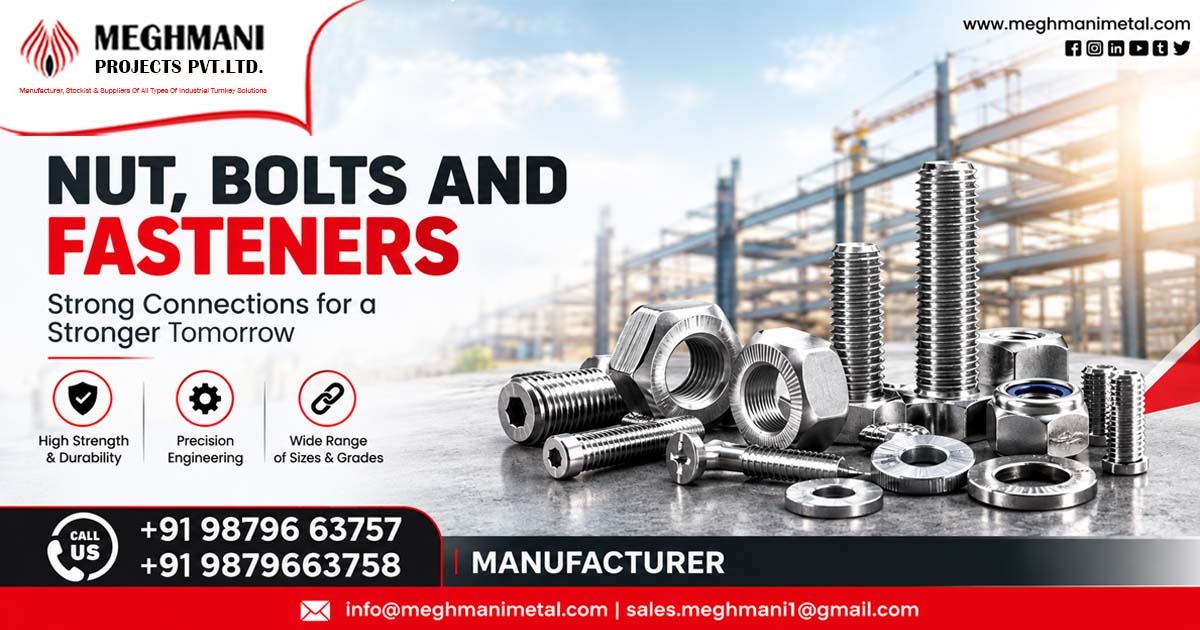
Industrial assemblies in Bharuch often depend on fasteners that match the joint, material, load, and operating environment. A reliable Nut, Bolts and Fasteners Supplier In Bharuch can help buyers source suitable components while maintaining dimensional consistency, material compatibility, and practical project requirements.
Start With the Joint Requirement, Not Just the Fastener Size
Nuts, bolts, and fasteners are mechanical joining components used to connect, secure, align, or hold industrial parts together. Selecting them only by diameter or thread size can create problems when the application has specific load, corrosion, temperature, or installation requirements.
Before preparing a purchase order, identify:
- Joint type and assembly arrangement
- Required bolt diameter and length
- Thread type and pitch
- Nut compatibility
- Material requirement
- Operating environment
- Expected loading conditions
- Required finish or surface treatment
- Quantity and repeat-order requirements
- Accessibility for installation and maintenance
For maintenance teams, replacing an existing fastener with a visually similar component is not always sufficient. Dimensions, thread compatibility, material, and application conditions should be checked before substitution.
Matching Fastener Material With the Working Environment
Material selection has a direct relationship with service conditions. An industrial fastener used inside a dry production area may have different requirements from one exposed to moisture, chemicals, outdoor conditions, or frequent cleaning.
Common considerations include:
| Requirement | What the buyer should examine |
| Corrosion exposure | Moisture, chemicals, outdoor exposure, or wash-down conditions |
| Mechanical loading | Joint load and expected service conditions |
| Temperature | Operating and surrounding temperatures |
| Compatibility | Interaction between fastener and joined materials |
| Surface condition | Required finish, coating, or corrosion protection |
| Maintenance | Ease of inspection and future replacement |
Stainless steel fasteners can be considered where corrosion resistance is relevant, while carbon or alloy steel options may suit applications where mechanical requirements and environmental conditions permit. The correct grade should be selected according to the actual application rather than assumed from appearance alone.
Thread, Dimensions and Fit Need Verification
A fastener can look correct and still be unsuitable if its thread or dimensions do not match the assembly.
Before ordering, buyers should confirm:
- Diameter: Check the nominal fastener diameter against the mating component.
- Length: Ensure sufficient engagement without creating interference.
- Thread: Confirm thread form, pitch, and mating compatibility.
- Nut pairing: The nut should correspond correctly with the bolt specification.
- Head configuration: Select the head type according to available installation space.
- Washer requirement: Determine whether washers are required for the particular joint.
- Quantity: Include installation, maintenance, and reasonable replacement requirements.
For repeat procurement, maintaining a standardized fastener list can reduce confusion between similar-looking sizes and simplify inventory control.
What Buyers Should Check Before Approving a Supplier
For industrial purchasing, the supplier evaluation should extend beyond price. A lower quoted rate may not provide value if the supplied fasteners do not match the required dimensions or material.
A practical supplier check can include:
- Product range relevant to the application
- Material and grade information
- Dimensional consistency
- Thread quality
- Surface finish
- Packing and identification
- Quantity accuracy
- Technical communication
- Custom or project-specific requirements
- Availability of repeat supply
- Documentation required by the buyer
- Response to quality or replacement concerns
Buyers should clearly communicate drawings, samples, specifications, or existing component references where available. This gives the supplier better information for identifying the required product.
Ordering Becomes Easier With a Clear Fastener Schedule
Large industrial projects can involve dozens of fastener sizes. A structured schedule helps procurement teams avoid mixing similar components.
A useful purchase schedule can include:
- Item description
- Fastener type
- Diameter
- Length
- Thread details
- Material or grade
- Finish
- Nut requirement
- Washer requirement
- Required quantity
- Drawing or reference number
- Application or assembly location
For maintenance inventories, grouping fasteners by equipment or assembly can also make future identification easier. This is particularly useful when several machines use visually similar components with different dimensions.
Installation and Maintenance Require Basic Control
Fastener performance depends not only on product selection but also on correct installation. Before assembly, mating surfaces and threads should be checked for visible damage, contamination, or incompatibility.
During installation:
- Use the appropriate tool for the fastener configuration.
- Avoid forcing mismatched threads.
- Check that the nut and bolt engage correctly.
- Follow the equipment manufacturer’s tightening requirements where specified.
- Inspect accessible joints after commissioning or maintenance.
- Replace visibly damaged or deformed components rather than reusing them when unsuitable.
During routine maintenance, look for loose joints, corrosion, damaged threads, distorted heads, and other visible signs of deterioration. Exact tightening or replacement intervals should follow the equipment manufacturer’s recommendations and the site’s maintenance procedure.
Simple Checks Can Help Identify Fastener Problems
Fastener-related issues are often noticed during equipment inspection, vibration checks, maintenance, or assembly.
| Issue | Possible Cause | Practical Check |
| Nut does not fit correctly | Thread mismatch | Verify bolt and nut thread specifications |
| Fastener loosens during service | Joint or installation issue | Inspect the joint and follow specified tightening requirements |
| Visible corrosion | Unsuitable material or environment | Review material and environmental exposure |
| Bolt does not seat properly | Incorrect length or configuration | Compare dimensions with the assembly requirement |
| Damaged thread | Handling, mismatch, or excessive force | Inspect both mating components before replacement |
| Repeated replacement | Application or joint issue | Review operating conditions and fastener selection |
Repairs involving critical structural or pressure-related assemblies should follow the applicable equipment procedure and competent technical guidance.
A Purchase Checklist for Industrial Buyers
Before placing an order with a Nut, Bolts and Fasteners Supplier In Bharuch, procurement and engineering teams can confirm the following:
- Is the fastener type suitable for the joint?
- Are diameter and length confirmed?
- Does the thread match the mating component?
- Is the material appropriate for the environment?
- Are nuts and washers correctly matched?
- Is the required finish clearly specified?
- Are quantities based on both installation and maintenance needs?
- Has any drawing, sample, or reference been shared?
- Are inspection or documentation requirements clear?
- Can the supplier support repeat requirements?
This approach helps reduce incorrect ordering and makes communication between engineering, procurement, stores, and maintenance teams more consistent.
Services
- Fastener requirement assessment based on project or maintenance needs
- Product selection support for size, material, and application requirements
- Assistance with customized or specification-based industrial orders
- Technical coordination for procurement and repeat supply requirements
Location
Bharuch has a strong industrial base, making dependable access to nuts, bolts, and fasteners relevant for plant maintenance, fabrication, construction, engineering, and industrial procurement. Buyers across Bharuch and nearby commercial and industrial centres can coordinate requirements with suppliers offering manufacturing support from Ahmedabad. Relevant locations include Bharuch, Ankleshwar, Dahej, Jhagadia, Panoli, Vagra, Jambusar, Hansot, Valia, Amod, Palej, Zadeshwar, Nabipur, Karjan, Vadodara, Halol, Savli, Padra, Kim, Surat, Ankleshwar GIDC, Dahej PCPIR, Jhagadia GIDC, Panoli GIDC, Bharuch GIDC.
Coordinating Industrial Fastener Requirements With Meghmani Projects
Meghmani Projects Pvt. Ltd. can assist buyers in discussing industrial fastener requirements based on product type, dimensions, material considerations, and project needs. For customers in Bharuch and surrounding industrial areas, the company provides manufacturing support from Ahmedabad, Gujarat, India.
When requesting a quotation, buyers can share their required sizes, quantities, material preferences, drawings, samples, or existing fastener references. This allows the requirement to be discussed more clearly before order finalization.
Frequently Asked Questions
Q: How should I select nuts and bolts for an industrial application?
A: Start with the joint requirements, dimensions, thread compatibility, material, environmental exposure, and loading conditions. The equipment or engineering specification should guide the final selection.
Q: Can stainless steel fasteners be used in industrial environments?
A: They can be suitable for applications where corrosion resistance is required, but the appropriate stainless steel grade should be selected according to the operating environment and material compatibility.
Q: What information should I provide when requesting a fastener quotation?
A: Share the fastener type, diameter, length, thread details, material or grade, finish, quantity, and drawing or sample reference if available.
Q: Why is thread compatibility important when buying nuts and bolts?
A: Matching thread specifications helps ensure proper engagement between mating components. Incorrect thread combinations can cause assembly problems or damage the fastener and mating part.
Conclusion
Industrial buyers in Bharuch need fasteners that match the joint, dimensions, material, and service environment rather than simply selecting standard-looking components. Careful specification, quality checks, and supplier communication can support reliable procurement. Meghmani Projects Pvt. Ltd. provides manufacturing support from Ahmedabad, Gujarat, India for industrial requirements.
Call Us:
Sales: (+91) 98 79 663757
Support: (+91) 98 79 663758
Email Us:
Sales: sales.meghmani11@gmail.com
General: info@meghmanimetal.com
If you have any more questions or customized solutions, please feel free to contact us.